
Stroke Impact on Family: When the Caregiver Becomes the Patient
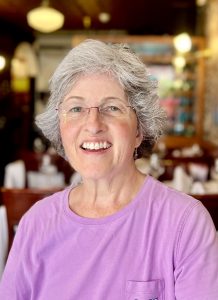
There is a particular kind of reckoning that happens when the person who has spent their life caring for others suddenly needs care themselves. For Kathy Cunningham, that moment arrived without warning.
For the person doing the supporting rather than the recovering, I recorded How To Help Someone After Stroke — what it looked like from the bed. A dollar.
Kathy worked in healthcare for years, a field built on attending to others in their most vulnerable moments. When stroke entered her life, she was confronted with something her training had never quite prepared her for: accepting help. In Episode 408 of Recovery After Stroke, Kathy sits down with her sons Sean and Paul Monahan to talk openly about the stroke’s impact on the family, not as a concept, but as a lived experience shared across three people who navigated it together.
When the Expert Becomes the Patient
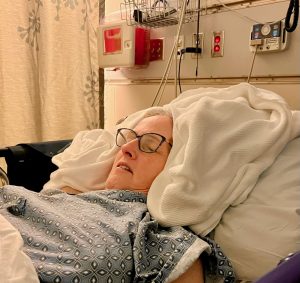
Healthcare professionals develop a particular relationship with illness. They understand the biology, know the pathways, and can often anticipate the trajectory of a condition before the patient has fully processed what is happening. That knowledge is a professional asset. In a personal medical crisis, it can also become a barrier.
Kathy’s background meant she understood exactly what a stroke meant and what recovery would require. What it did not prepare her for was being on the receiving end: needing to ask, needing to wait, needing to trust others to do the things she had always done herself.
Her sons Sean and Paul were part of that support system, two adult men who stepped into a caregiving role they had never anticipated, in a household that was already carrying more than most.
A Household Navigating Stroke More Than Once
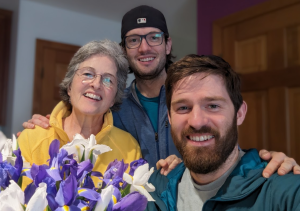
What makes Kathy’s story particularly complex is the context it unfolded in. Her household had already been touched by stroke before her own diagnosis, meaning Sean and Paul weren’t approaching caregiving as something entirely new. They were deepening an already demanding commitment.
The stroke impact on family is rarely a single event. It accumulates. Each new development shifts the balance of who does what, who needs what, and who is available to give it. For Sean and Paul, supporting their mother meant learning to hold space for her recovery while managing the weight of their own experience alongside it.
That is the part of stroke that rarely makes it into clinical documentation: the sustained psychological and logistical load that falls on the people closest to the survivor, day after day, over months and years.
The Challenge of Accepting Help
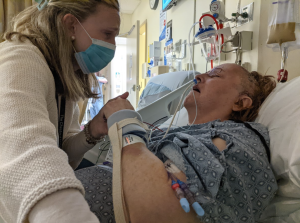
One of the most consistent patterns across stroke recovery is the difficulty survivors have in accepting help, and it is amplified, not softened, when the survivor has a background in caring for others. The implicit logic runs: I know how this works. I should be able to manage this.
Kathy speaks to this directly in the episode. The process of allowing her sons to step forward to organise, to accompany, to simply be present and available required a different kind of skill than anything her career had developed. It required recognising that accepting care is not evidence of incapacity. It is its own form of strength.
For families supporting a stroke survivor, this distinction matters. When a survivor resists help, it is not always stubbornness. Often, it is someone navigating an identity that has been fundamentally disrupted by what happened to them.
What the Family Perspective Adds
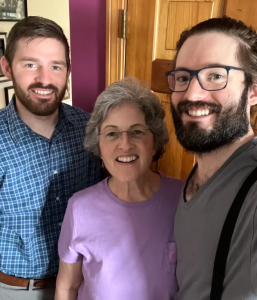
Sean and Paul’s presence in this conversation shifts something in the usual stroke recovery narrative. Most episode conversations centre on the survivor. This one deliberately includes the view from the other side, the sons who watched, worried, helped, and carried their own weight through it.
What they share is instructive for any family in a similar position. Stroke impact on family plays out differently depending on who is watching, who is helping, and who is still finding their way back to the person they knew before the stroke. Their account is not about burden. It is about recalibration, finding a new way to be a family when every role has shifted.
What Families Can Take From This Conversation
If you are supporting a stroke survivor or a survivor who has struggled with accepting help, three things stand out from this episode.
The first is that a survivor’s professional identity shapes their recovery. Someone who has spent their career as a carer may need more time and explicit permission before they can accept care themselves. Naming this directly with patience, not pressure, opens the door.
The second is that adult children carry more than they show. Sean and Paul’s willingness to speak plainly about their experience is a reminder that caregiving has an interior weight that often goes unspoken. Creating space for that conversation within a family is not weakness. It is what keeps families intact through long recoveries.
The third is that stroke impact on family is not a moment – it is a process. It evolves, shifts, and asks different things of different people at different stages. Families who move through it with honesty tend to find a stronger dynamic on the other side.
If this episode resonates with you, Bill’s book The Unexpected Way That A Stroke Became The Best Thing That Happened explores the tools that have helped stroke survivors and their families navigate the long road back. You can find it at recoveryafterstroke.com/book.
If the show has helped you or someone in your life, you can support it financially at patreon.com/recoveryafterstroke.
This blog is for informational purposes only and does not constitute medical advice. Please consult your doctor before making any changes to your health or recovery plan.
The Nurse Who Had to Learn to Accept Care | Kathy Cunningham with Sean & Paul Monahan
When the family’s caregiver becomes the patient, everything changes. Kathy Cunningham and sons Sean and Paul Monahan share the unfiltered truth.
Highlights:
00:00 Kathy’s Life Before the Stroke
03:54 Family Reactions and Hospital Experience
12:31 Coping with the Aftermath
15:33 Stroke Impact on Family
21:24 Reflections on Control and Independence
28:33 Facing Mortality: A Son’s Perspective
35:19 Navigating Family Dynamics During Crisis
45:28 Understanding the Impact of Stroke on Relationships
53:21 Finding a New Normal After Recovery
01:04:58 Reflections on Healing and Future Aspirations