EWOT for Stroke Recovery: The Affordable Alternative to Hyperbaric Oxygen Therapy
![]()
Brad Pitzele did not set out to become an oxygen therapy equipment maker. He set out to survive. After years of battling significant health challenges, conventional medicine had given him answers that kept failing him. He tried around 200 treatments. Some helped. Many did not. Then he found EWOT Exercise With Oxygen Therapy, and something finally shifted.
Brad’s journey is not the same as a stroke. But what he discovered about oxygen, inflammation, and cellular energy maps directly onto one of the most stubborn obstacles stroke survivors face: the feeling that the brain has gone offline, that the body is running on empty, and that the path back is either impossibly expensive or simply does not exist.
In Episode 407 of the Recovery After Stroke podcast, Brad shares what EWOT is, why it works, and why he now makes affordable EWOT systems through his company, One Thousand Roads, specifically so survivors do not have to remortgage their homes to access oxygen-driven recovery.
What Is EWOT?

EWOT stands for Exercise With Oxygen Therapy. The concept is straightforward: you breathe high-concentration oxygen through a mask while exercising even lightly, and that combination pushes oxygen into parts of the body that normal breathing cannot reliably reach.
Most people assume oxygen therapy means a hyperbaric chamber: a pressurized tube, a clinic, a course of treatments costing tens of thousands of dollars. Hyperbaric oxygen therapy (HBOT) is effective. Brad describes it as “a heroic treatment.” But it is also inaccessible for most survivors, financially and logistically.
EWOT operates on a related principle without the chamber. The key mechanism is not about oxygenating red blood cells; they are already carrying close to their maximum load under normal breathing. The target is the blood plasma. Plasma does not carry oxygen efficiently under resting conditions, but during exercise, even light exercise, blood pressure and circulation increase enough to force dissolved oxygen into the plasma. That plasma can then reach the micro-capillaries, the tiny vessels that feed tissues deep in the body, including areas of the brain that become inflamed and oxygen-starved after a stroke.
The Post-Stroke Energy Problem
One of the most commonly reported and least-explained symptoms after stroke is fatigue that does not go away, no matter how much a survivor rests. Most survivors are told that is just part of it. Brad’s framework centres on mitochondrial dysfunction.
Mitochondria are the energy-producing structures inside cells. After stroke, the cells in and around the affected area are often not dead; they are in a kind of low-power state. Brad describes it as a “brownout”: the lights are on, but dimly. The mitochondria are not producing energy at full capacity, and one significant reason for that is insufficient oxygen supply to the tissue.
“The cells that are offline after a stroke are not all dead. Some of them are just starving. Oxygen is part of what feeds them back.” — Brad Pitzele, Episode 407
When EWOT increases plasma oxygen during exercise, it can reach those inflamed, under-oxygenated micro-capillaries that larger vessels cannot access. The result, for some survivors, is a gradual improvement in energy, cognition, and physical capacity, not because the therapy is miraculous, but because it addresses a specific physiological deficit that conventional post-stroke care often does not target.
EWOT vs. Hyperbaric: What’s the Real Difference?

The honest answer is that EWOT and hyperbaric oxygen therapy are not equivalent. HBOT delivers oxygen under pressure, which drives it into tissue more forcefully. For certain conditions, particularly in acute or severe cases, hyperbaric oxygen has a stronger evidence base.
But for many stroke survivors in the subacute or chronic phase of recovery, access is the defining variable, not theoretical ceiling. A home-based hyperbaric unit costs $50,000 to $75,000. A clinical course can run to $60,000 or more. EWOT systems are available for under $2,000.
The question Brad puts to survivors is not “which is better in a lab?” It is: “Which one can you actually do, consistently, at home, over the months and years that brain recovery requires?” Consistency matters more than peak intensity in long-term neurological recovery.
Starting EWOT With Deficits
EWOT does not require running on a treadmill. The exercise component can be a stationary bike, a recumbent bike, or simple seated leg movements with one limb strapped in. The goal is to raise circulation enough to push oxygen into the plasma, not to hit a cardiovascular fitness target.
For survivors exploring this option, Brad’s team has built a specific resource at onethousandroads.com/stroke-recovery with a listener discount of $100 to $500, depending on the package. There is also a broader introduction to EWOT at onethousandroads.com/pages/exercise-with-oxygen-therapy.
Recovery Is Possible — And It Does Not Have to Be Expensive

If this episode resonated with you or if you want to explore more conversations about recovery options that do not require a second mortgage, Bill’s book, The Unexpected Way That A Stroke Became The Best Thing That Happened, is available at recoveryafterstroke.com/book.
And if the Recovery After Stroke podcast has been useful to you, you can support it financially at patreon.com/recoveryafterstroke. Every contribution helps keep the show going and these conversations accessible to survivors around the world.
This blog is for informational purposes only and does not constitute medical advice. Please consult your doctor before making any changes to your health or recovery plan.
EWOT for Stroke Recovery: The Affordable Alternative to Hyperbaric Oxygen Therapy
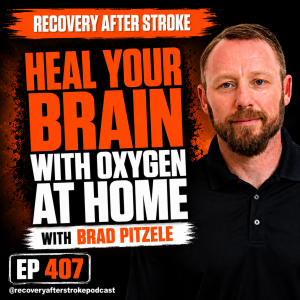
Why pay $60,000 for hyperbaric oxygen? EWOT brings oxygen therapy into your living room — and could help the brain cells that are only offline.
One Thousands Roads
Exercise With Oxygen Therapy (EWOT)
YouTube Channel
Highlights:
00:00 Introduction and Background
05:37 Challenges in Stroke Recovery and Treatment Options
13:45 Understanding Oxygen Therapy and Its Mechanism
15:51 Oxygen Toxicity Explained
19:24 The Importance of Oxygenating Blood Plasma
24:53 Oxygen and Mitochondrial Function
31:16 Adapting Exercise for Stroke Survivors
38:27 Cost and Accessibility of Oxygen Therapy Devices
Transcript:
Introduction – EWOT for Stroke Recovery
Brad Pitzele (00:00)
like many of your listeners, when you have a medical issue that isn’t treated by traditional medicine and you’re desperate to get your life back, you’ll try just about anything. You, the lens it goes through is like, Well, how bad can this hurt me?
BIll Gasiamis (00:15)
Welcome back to Recovery After Stroke. I’m your host, Bill Gassiamas. Today’s guest is Brad Pitzele, founder of 1000 Roads, who overcame significant health challenges of his own and along the way discovered the science behind exercise with oxygen therapy. In this conversation, we get into how increasing oxygen saturation in the blood, specifically in the blood plasma, can help reach the inflamed microcapillaries.
That are blocking oxygen delivery to cells in the recovering brain. We talk about mitochondrial dysfunction, post-stroke fatigue, and why Ewatt is worth understanding as an accessible alternative to hyperbaric oxygen therapy. Before we get into it, if you’ve found value in this podcast and want to support it financially, you can do that at patreon.com/slash recovery after stroke.
And if you haven’t yet read my book, The Unexpected Way That a Stroke Became the Best Thing That Happened, it is available at recovery after stroke dot com slash book. Here’s my conversation with Brad.
BIll Gasiamis (01:19)
Brad Pitsley, welcome to the podcast.
Brad Pitzele (01:22)
Thank you so much.
BIll Gasiamis (01:24)
Thanks for reaching
out and ⁓ connecting with me to educate me on another thing that I can bring to stroke survivors that could potentially help them in the rehabilitation side of their brain. The the thumbnail that people found on YouTube is probably gonna have E W O T on it somewhere. E what. And it sounds something like something out of that ⁓ space war out of out of what is it?
Brad Pitzele (01:53)
Star
Wars. Star Wars.
BIll Gasiamis (01:54)
Star Wars.
Like the Ewok, right? And it doesn’t really mean anything to me. But before we descri tell people what Ewok is, ⁓ tell me a little bit about your background, the work that you do and how it is you came to be on the podcast today is for s for for the specific discussion that we’re gonna have.
Brad Pitzele (01:58)
Yep.
Sure. ⁓ yeah, so I ⁓ I I’m an e recovering engineer. I like to joke. I spent my first decade of my life engineering. later on in life, I left engineering and went into different pursuits and I became chronically ill, had a variety of medical issues, ⁓ cancer, autoimmunity, and eventually Lyme disease.
And I was in really bad shape. And a doctor recommended I look into either hyperbaric oxygen or this exercise with oxygen therapy, EWAT, that almost no one had heard of, and I’d never heard of it. ⁓ I I I had tried like everything to get better at this point. I was many years in special diets, ⁓ all sorts of supplements and ⁓ all sorts of modalities and things. And
nothing really worked. There was nothing in a matter of fact, some of the medications I took actually gave me cancer. So it kind of forced me on this road to try something different. ⁓ and eventually I found my way back to health through exercise with oxygen when so many things weren’t working. ⁓ and actually later paired that with ⁓ red light therapy. ⁓ and along the way I started because I’m an engineer and I’m inquisitive, I like
It was Lyme disease is kind of a do-it-yourself disease. ⁓ so I started digging in and pouring into research, not just on Lyme disease, but autoimmunity, ⁓ chronic illness, ⁓ trying to figure out what the heck was going on with me. And so ⁓ what I found about exercise oxygen therapy along the way was really fascinating to me. and about a year into using it, I went back to that same doctor and he was kind of shocked.
At my turnaround, and he was like, What did you use? Did you do oxygen? And I said, I did. And he was like, Who’d you buy it from? I want to tell my patients about it. And I said, I didn’t buy it, Doc. I actually ended up making my own. And he was kind of surprised by that for obvious reasons. And then he said, Well, gosh, would you consider making it for my patient? And so, my patients, and so
that’s how we got into this business back in two thousand eighteen. We launched one thousand roads to kinda make exercise with oxygen therapy accessible to people who are dealing with chronic health conditions.
BIll Gasiamis (04:39)
Okay. And it stems from science, right? There’s scientific data that backs up this exercise with oxygen therapy. Before you go into that a little bit, we don’t have to go deep into it, but we can just ⁓ chat about it. ⁓ when I talk to stroke survivors, they get stuck always with what should I do? What should I do? What should I do? They want the
The blue pill, take that one, everything gets fixed. I mean, stroke is not like that, right? And it’s and it’s stroke is also a you’re on your own kind of thing. Because once you get out of the acute phase, once you get sent home, the ⁓ follow up and the medical fraternity doesn’t have a system to kind of say to you, we can’t help you. Speak to that guy. ⁓ that guy might not be able to help you, but but there’s a guy over there.
Brad Pitzele (05:09)
Yeah.
Challenges in Stroke Recovery and Treatment Options
BIll Gasiamis (05:33)
Like there’s none of that. And stroke survivors need podcasts. They need ⁓ people selling all sorts of crazy stuff that they will almost try almost all the time. They’ll try everything. And then they’ll pick and finally stumble into one that helps and gets them a result. But before we talk about all of that, what I want to do is also go back to what you said about ⁓ a year later, you went to your doctor, he was stunned at the result.
We can’t put that down just to eat what? We can’t put that down just to exercise with oxygen therapy. Give me the brief steps on the other things that you also attended to because people miss that.
Brad Pitzele (06:15)
Yes.
Yeah.
I well, here’s what I’ll tell you. I started I started to get arthritis in my hands in like 2010 or eleven. and then I started taking traditional drugs for it. And one of the side effects of the drugs is higher risk of cancer and specifically melanoma, which I developed in two thousand thirteen, I wanna say, maybe two thousand fourteen.
And that kicked me off the traditional medical path. ⁓ to your point, you don’t you don’t in the stroke recovery, there’s not a traditional path. There it was a traditional path, but it was clear that it was a you know it was a choice between cancer and autoimmunity, and neither one seemed great to me. ⁓ from there I tried so many things, Bill. I did s I actually made a list recently and looked at it because I had it like just off the top of my head, I came up with 200 different things I did try. We’re talking special diets.
Eating all sorts of weird, strange things, all sorts of supplements, antibiotics, because it’s Lyme disease, herbal protocols, ⁓ ozone treatments, sa various different types of saunas, ozone sauna, infrared sauna, ⁓ heat steam saunas, ⁓ colonics, coffee enemas, ⁓ weird stuff, you know, you’d never think you’d do. I mean
BIll Gasiamis (07:39)
You are committed
Brad Pitzele (07:42)
‘Cause
like many of your listeners, when you have a medical issue that isn’t treated by traditional medicine and you’re desperate to get your life back, you will you’ll try just about anything. You the the lens it goes through is like, Well, how bad can this hurt me?
Like like ’cause I know where I’m going right now. For me at least it was a I was just like this gradual step down.
It was like I knew like I I couldn’t do this. I had a young family. so, you know, that doctor, I remember him saying, like, look, Brad, we’re trying all these things, we’re gonna get you on thyroid medications and get that right, and we’re gonna do this. ⁓ there on that list of 200, there were about eight things that gave me any kind of benefit that I could identify. ⁓
But I remember he’s like, Brad, we’re gonna take out the big dog. We’re gonna do this ozone treatment. And it’s a special kind where we remove the blood from your body, we inject ozone, put it through UV light, and put it back into your blood. And this helps everyone. Like if nothing else works, this helps, but it’s really expensive. So we’re saving it, kind of. So he he did it. He’s like, do a course of three of them. And he’s like, You might feel bad after it the next day because it kills a bunch of stuff and might you might feel toxic. Or you might feel better. We’re not sure.
And give it a few days. And like I did all three of them, I never noticed a difference. And it was ⁓ the most depressing, scary part was like going through that. So when he said go do oxygen, I was like, Okay, like I’ve done everything else. I’m just gonna check the box so the doctor knows that’s not gonna work, so we can go try to find something else. ⁓
And I didn’t believe it was gonna work. I I you know, I didn’t jump on the the bandwagon gung-ho. I was, you know, kind of kicking and screaming. And that was part of the reason I built my own, is because at the time they were so expensive and the they were five to twenty-five thousand dollars. And I was like, I just can’t spend, you know, ten thousand dollars on an experiment. I just can’t do that. ⁓
And he also suggested maybe hyperbaric and that was like fifty or seventy-five thousand dollars. And I was like, geez, if I knew this was the the blue pill, as you said it, if I knew this was the blue pill, I’d go mortgage the house and I’d go do it because like then I could work full and I could do all the things, I could be present for the family, but ⁓ I couldn’t.
BIll Gasiamis (10:05)
And and and
you know what? And it’s not, and and the reason it’s not for a lot of people is because you need to have penumbras the brain from a stroke survivor perspective that are recoverable and that you can bring back to life that are offline, not dead by ⁓ cell death because of the stroke. And there’s no diagnostic process in the majority of the people I’ve spoken to, you can’t diagnose somebody and then work out whether they’re a candidate, and that really
Brad Pitzele (10:20)
Yeah. Right.
BIll Gasiamis (10:33)
Pisses me off to somebody gonna have to spend 50 grand to find out if they’re gonna get a result, right? The s the guys that who I’ve interviewed about hyperbaric oxygen therapy, ⁓ Viv clinics, ⁓ those guys will do a thorough diagnostic beforehand to determine whether somebody is a candidate. And whatever that costs, even if it’s five grand, I don’t know what it does cost, but even if it’s five grand, at least you can go, you’re not a candidate, don’t spend any more money.
Brad Pitzele (10:38)
Yeah.
Right.
higher yes, you have a higher level of certainty
before you spend the money.
BIll Gasiamis (11:04)
Yeah. And if you do do it, you’re doing it for the other ⁓ non-brain related benefits that you’re gonna get from hyperbaric oxygen therapy. And that’s totally up to you. But it’s not the thing to supposedly fix the arm or the leg that doesn’t work, or to ⁓ repair the damaged cells in your brain. So that part really frustrates me. And if I’m gonna spend that much money, then there’s the opportunity cost as well. It’s like
Brad Pitzele (11:33)
Yes.
BIll Gasiamis (11:34)
Now I
can’t spend that somewhere else.
Brad Pitzele (11:36)
Exactly. That was me too. It was like you you knew you had and I was like, man, if I spend this kind of money on it and it doesn’t work, like nothing’s worked for the last, I don’t know, almost ten years at this point. Like how many of these shots do I have in the cannon, right? Like you you know, now I’m I’m depleted and I’m still sick. And that’s even i and you know this, when you’ve got a chronic health condition, sometimes the psych psychology of it all is just as hard as the condition. And
If you’re like, wow, now I don’t have money. I feel trapped. There’s nothing I can try. Then hope starts to dwindle. And I
say like hope is is like the most potent weapon in recovering from a chronic health condition. It’s a double-edged sword because like you’re s afraid to get hope up because you’ve been let down. But it’s also the thing you need. You ha like when when you start losing hope, and I and I’ve been at that point, it just gets incredibly dark.
⁓ and incredibly scary.
so I I think that was part of it. I just wouldn’t allow it. It was the financial part. I you’re right. You only have so many shots out of the bow. But it was also like if it doesn’t work and I am depleted financially you know, I don’t like that that brings me to a a level of hopelessness I I’m not sure I can confront.
BIll Gasiamis (12:53)
Yeah. And then in order to get back up, you’re getting back up, you’re financially depleted, you’re energetically depleted, your health is depleted. And it’s like, my God, that is a that is like the lowest place that you can find yourself and to get back up is a lot harder. And yet people have still done that, but I know the task is harder. I’ve been in a similar sort of situation.
Brad Pitzele (13:12)
Yeah.
We all love
we all love reading that inspirational story. No one wants to live it if they can avoid it, I’ll tell you.
Understanding Oxygen Therapy and Its Mechanism
BIll Gasiamis (13:23)
Avoid it. Yeah, a
hundred percent. ⁓ so so you’ve tried all this stuff, you’re unwell, and then somebody says to you, try oxygen. Now, what I imagine when I hear oxygen is get a can from the local gas supplier, ⁓ pop pot in a tube, put it on the back of your chair, wheelchair. You know, I’ve seen a lot of older guys who have got it, and then they’ve got oxygen attached to their face and they’re breathing in oxygen. What specifically did
your doctor tell you to get and if you didn’t get what he suggested, like w what did it look like for you?
Brad Pitzele (14:00)
Yeah, so the challenge with bottled oxygen is number one, it’s almost impossible to get. number two is when you exercise, you can take in a massive amount of oxygen, and that’s part of what makes the the therapy really cool. So y you and I sitting here, maybe we’re taking in three liters of oxygen a minute, okay? ⁓ three liters of air a minute, maybe something like that. ⁓
When you’re exercising, you can easily take in 50 or 60 liters. So it’s a massive multiplier. So you need something that’s going to give you a large amount of oxygen. Now, there’s two ways you can get oxygen in your home. One is that bottle you mentioned, and then you’re always refilling it, and you can imagine lugging one of those things around. ⁓ the other way is there’s a device called an oxygen concentrator, and all you do is you plug it into the wall.
And it turns the it purifies the oxygen in the room. So, you know, at sea level, the oxygen in the room has 21% oxygen and it can purify it to 93%.
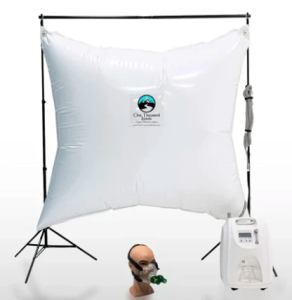
Now, the challenge with these devices is they put out either five or ten liters of oxygen in a minute. So not enough to exercise with. If you were to try to exercise with it, you would also be sucking in this air at 21% and diluting it. ⁓ and so what you do is you take this device and you fill a large reservoir, it’s about a thousand liters, ⁓ and you fill it up.
using this device and then you hook up a hose with a mask on it and then you breathe through the mask while you do a fifteen minute exercise session.
BIll Gasiamis (15:41)
Okay. A reservoir, ⁓ water tank.
Oxygen Toxicity Explained
Brad Pitzele (15:45)
It well it it’s like it looks like a big pillow. So it’s like six you know, two meters by two meters, sort of ⁓ big pillow, six feet by six feet for us still on Imperial. And you fill it up so a thousand liters and it’s you know it’s it’s thin film and so it’s not a a rigid body of something, and then yeah, it’s a bag.
BIll Gasiamis (16:06)
It’s a bag. Like
a bagpipe, a massive bagpipe.
Brad Pitzele (16:10)
There you go.
BIll Gasiamis (16:12)
Okay. Okay. W I’m sure there’s an image of that, right? We’ll put it on the screen. People can see it while we’re talking about it, trying to work out what it is. Okay. So this thing is something that you accessed and you used specifically for yourself, how many years ago?
Brad Pitzele (16:16)
Yeah. Yeah.
I’ve s I’ve been using it for a decade straight now.
BIll Gasiamis (16:33)
Okay. This stuff’s been around for about a decade. This
Brad Pitzele (16:37)
It’s well, the the research on it goes back to the nineteen sixties and seventies. This it’s really fascinating. actually some of the early research goes back to the turn of the ⁓ twentieth century, the nineteen hundreds. So in the early nineteen hundreds, a gentleman named Otto Warburg won a Nobel Prize for proving that he could turn any cancer or any regular cell into a cancerous cell by depriving it of oxygen.
⁓ and so there’s this really well-established linkage between oxygen and cancer. Even today, a ton of research on that. So in the 1960s and 70s, there was a a German physicist and prolific inventor named Manfred von Arden. Now, and he started to want to do research on Otto’s work, and he he actually started doing research on exercising with oxygen as an anti-cancer protocol.
And some of the research he found was really fascinating. what without getting overly technical, basically it our circulatory system, obviously, this is really relevant to stroke, ⁓ people deal in strokes, is as you get down into the the end runs of your circulatory system, there’s capillaries and they’re like thinner than a human hair. And this is where your nutrients and your oxygen are actually exchanged with the cell.
And what he found is as we age naturally this inflammation builds up on the lining of our capillaries. And it actually causes the capillaries to swell shut so that now none of your red blood cells can get by. Now, I mean, this is how exquisite our body is designed. ⁓ our capillaries are actually thinner than a red blood cell. So under the most healthy of conditions.
A red blood cell actually needs to fold up like a taco to get into our capillaries and deliver that oxygen in the last mile of our circulatory system. So any
swelling in that capillary can cause a blockage. And now all the cells downstream are not getting oxygen and in a sufficient quantity. And so they kind of go into what they what he kind of referred to as like a brownout, right? Like it’s a low energy state. They’re doing anaerobic respiration to get some energy. Maybe some of the smaller red blood cells might squeak by here and there and give a little bit, but they’re not getting the full oxygen they need. And what he found is by doing this procedure,
just a few times he had very elderly people with very inflamed ⁓ capillaries. He was able to re-establish normal blood flow. And the reason is is oxygen is incredibly anti-inflammatory. ⁓ and a lot of research on that we can go into a little bit later.
The Importance of Oxygenating Blood Plasma
So, number one, it causes this anti-inflammatory reaction inside these inflamed capillaries to reopen them. But it also does something really amazing that he discovered is when you’re doing this procedure, ⁓ it causes the oxygen to not just attach to our red blood cells like it always does, but it also saturates our blood plasma, which is this clearish liquid that our red blood cells ride on. And
Our blood plasma is a thousand times thinner than a red blood cell. So if you imagine these blockages, red blood cells are not getting through, but obviously the blood plasma can get through as long as it’s like as thin as water. So as long as there’s any opening there, and it can immediately deliver oxygen downstream, both to cause an anti-inflammatory impact in the capillaries, but also to all those cells that are starving. And so you can obviously, as we’re talking through this, you can kind of
see how this fits folks who are dealing with various different strokes ⁓ and how that can help them as well.
BIll Gasiamis (20:32)
Yeah. Okay. I d before we spoke I did a little bit of research and found ⁓ as well that there’s some there’s a lot of relevant data with regards to oxygen and ⁓ increasing the oxygenation in the blood. you so tell me a little bit about oxygen. I I don’t understand exactly what that is. I’ve heard of people becoming ill.
Because of too much oxygen, ⁓ ill because of not enough oxygen. So what is what what is becoming ill of too much oxygen and why is ninety nine percent saturation not that?
Brad Pitzele (21:18)
Yeah, yeah. ⁓ good question. So oxygen toxicity can occur if you get too much oxygen under certain circumstances. So if you’re in a hyperbaric chamber too long, it can cause oxygen toxicity. And basically that’s when oxygen gets trapped in your bloodstream and it can’t get out. and
You can actually get it without hyperbaric. So hyperbaric is oxygen under pressure. You can get it at normal barracks. So if you were just sitting on the couch breathing oxygen, you could eventually get oxygen toxicity. Now, it would take over twenty-four hours. So if you were breathing just pure oxygen, no exercise, sitting on your couch for 24 plus hours, it starts to get into the risky zone.
When you’re doing exercise with oxygen, that’s actually one of the cool things about it that because of the synergies of exercise and oxygen, it’s impossible to get oxygen toxicity for two reasons. one is that reservoir is only a thousand liters. it’s not a high enough dose that you could get a oxygen toxicity. It is a massive dose, it’s about the same amount of oxygen you take in in a day, and you can take it in in 15 minutes, but it’s not more than.
And the second reason, even if we could make our reservoir 10x, 100x, and you could exercise nonstop, you still couldn’t get oxygen toxicity because when you’re exercising, your body produces a massive amount of carbon dioxide gas.
And that goes into our bloodstream and it increases pressure in our circulatory system. And that actually forces the oxygen out of the circulatory system and into the cells. So it works as a protectant as well from oxygen toxicity. So that’s oxygen toxicity. It’s a real risk. ⁓
Most of the time it’s a very controllable risk. You know, if you’re doing hyperbaric, they’re gonna keep you in there for so long so that you’re not gonna be at risk generally. ⁓ if you’re assigned to do oxygen while you’re stationary at home, they have protocols to make sure you’re not doing it, you know, twenty-eight hours nonstop sort of thing. ⁓ or they have you wear a cannula where where you’re also taking in air and it’s diluting it.
⁓ and in exercised oxygen therapy, it’s not really possible because of the massive amount of carbon dioxide. ⁓ now, not enough oxygen. So if you if you want to measure your oxygen in your blood, the way they normally do it is a device called the pulse oximeter. You can get one for 20 bucks off Amazon. What it does is it looks at how much how many of your red blood cells are saturated with oxygen. And what you’re gonna find in most folks.
Is it’s close to a hundred percent. It’s ninety-eight percent, it’s ninety-six percent, ninety-seven percent. ⁓ there’s not a lot of room in our blood for more oxygen. So that’s why it’s important that ewak can actually oxygenate our blood plasma. The same with hyperbaric does the exact same thing, it oxygenates our blood plasma. So
BIll Gasiamis (24:26)
Okay. I think before you go on,
that’s the key ingredient. It’s oxygenating the plasma as well. Where where previously you’ve got let’s say ninety seven, ninety eight percent saturation of your red blood cells. What we’re doing is adding that little bit of extra oxygen into the space where the plasma is. That’s kind of the key difference.
Brad Pitzele (24:36)
Yes.
And there’s two reasons why it’s important. so normally, just for comparison, you and I sitting here, maybe 2% of all the oxygen in our blood is in our plasma, so it’s not very much. ⁓ but under these conditions of IWAT and hyperbaric, we can saturate that blood plasma. And it’s important for two reasons. One, obviously, it increases the oxygen carrying capacity of the blood, but that’s the more minor one. The more major one is that the blood plasma can get into
let’s just say the nooks and crannies, smaller spaces in our body where inflammation is blocking off access of red blood cells to downstream cells. And so it can deliver a dose of oxygen where it normally is not able to get.
BIll Gasiamis (25:40)
You you’ve spent a lot of time on this topic by the sound of things. ⁓ and that’s really awesome. So before we talk about how to actually use a device, how to get a device, how to how to behave while you’re using a device, I wanna understand like how
Oxygen and Mitochondrial Function
Brad Pitzele (25:52)
Yeah.
BIll Gasiamis (26:02)
How you notice the difference in yourself? Because a lot of people ask me what I did in my own stroke recovery. And Brad’s experience is going to be different from the stroke survivor’s experience. My experience was ⁓ I’ve got nothing from the doctors other than let’s monitor your bleed, let’s give you brain surgery. I mean, that’s not nothing. That’s amazing. Like I’m very
Brad Pitzele (26:05)
Yeah.
Yes.
BIll Gasiamis (26:31)
Grateful for all of that. That removed the the blood vessel that was leaking that was going to potentially kill me. ⁓ so the immediate risk was gone. And then what what I mean I I got nothing is the specialists did their specialty and then I got nothing because they don’t do nutrition, they don’t do exercise, they don’t do meditation, they do brain surgery. And it’s really important for stroke survivors to understand that when you go to a doctor, a neurologist, whoever.
Brad Pitzele (26:55)
Yeah.
BIll Gasiamis (27:00)
They do a specific thing, and once they’ve done it, they can’t do anything else. And you need to get over the fact that you ⁓ might feel disappointment at the at that I don’t know where to go next, and they don’t know where to send you. Okay, they’re not trained and they cannot legally send you elsewhere. That’s why you’re kind of on your own. So I did meditation, I did nutrition, I did all this kind of stuff and
Brad Pitzele (27:16)
Yeah.
BIll Gasiamis (27:27)
Somebody who’s interviewed you is Dave Asprey. I would I’ve been following Dave Asprey and a whole bunch of other guys ⁓ probably since around 2012, 2013. And what I learned was how do I reduce the inflammation in my brain? And I had that one area of inquiry, the one area of inquiry that I could personally impact positively by taking out inflammatory foods from my diet.
And before that it was, you know, ⁓ processed white bread, it was alcohol, it was cigarettes, ⁓ it was all the stuff that you get in a packet that doesn’t really help to nourish the body, right? So I went back to basics. We’ll call it just for the simplicity of the explanation, we’ll call it protein, ⁓ vegetables and basic carbohydrates like rice or potato.
And then what I found was that inflammation decreased, and that was a game changer in how I experienced my brain. And it was a game changer in how quickly I improved neurologically. But just so that people know, it wasn’t the be all end all, it didn’t remove the damaged cells that still are in my head that mean I experienced my the left side of my body in a completely different way than my right side.
I’ve got numbness, proprioception issues. I’ve got ⁓ tingling, I’ve got burning, I’ve got ⁓ spasticity, you know, the muscles are tight. So all that stuff is still there. But I have a better experience of the rest of my body and brain because of the things that I took out. But what I didn’t have was the link between exercise, which I do, light exercise, because I’m a stroke survivor. I can’t.
use the left side of my body like I used to. so I would do exercise ⁓ like riding an electric bike because it’s easier to pedal, like walking and like doing very light weights at the gym. ⁓ but I didn’t have that oxygen part of the the therapy. And that’s kind of why I interviewed the guys about hyperbaric to understand how oxygen supports how
mimicking i a hypoxic brain in the chamber supports ⁓ so how how does like what’s the next part like how does that support the brain to heal let’s give stroke survivors an understanding so that they can kind of grasp that I know we spoke about how oxygen gets into the ⁓ into the red blood cell we spoke about how it gets into the plasma but like
Brad Pitzele (30:15)
Yeah.
BIll Gasiamis (30:20)
Why is that the next step?
Brad Pitzele (30:21)
What’s it too?
Yeah. It’s a good question. I think you’re right. I you know, we don’t I will say we don’t try to go out and pitch like exercise with oxygen therapy is a panacea or it’s everything for everyone. Even the name of our company, ⁓ one thousand roads, is about paying homage to everyone’s own healing journey and recognizing everyone’s unique journey.
So I’ll say that, but
So I’ll say that, but what I found about oxygen was in IWA in particular. What was fascinating to me was for me when I was dealing with Lyme disease, which similar to folks who are dealing with the stroke, there’s a variety of different symptoms and s from different causes. And I was trying to treat all these things with different protocols, different supplements that and I found that when I started digging into oxygen, I was shocked at how many of them came back to it. So when you have
A stroke, often there’s a lot of ⁓ emerging research about mitochondrial dysfunction. And this is interestingly, mitochondrial dysfunction. Now ten years ago when I was researching it, no one heard of it or cared about it. And it’s really burst onto the scene because you’re gonna find it
⁓ At the heart of so many chronic health conditions, right? ⁓ you’re gonna it’s actually they’re looking at it in cancers, ⁓ chronic illnesses of all sorts, Alzheimer’s, all sorts of cognitive and ⁓ autoimmune conditions, etc., etc. So ⁓ you have this disrupted mitochondria, right? So there was a period of time when your cells were not getting enough energy, whether it was a hemorrhagic stroke and
Blood wasn’t being delivered to those cells, so no nutrients, no oxygen, or an ischemic stroke where they were just cut off ⁓ because of a clot or whatnot. And so they were not getting nutrients. In each of these cases, what happens immediately when the cell runs out of oxygen, like I was talking about that brownout, it goes from aerobic respiration to anaerobic respiration. And anaerobic respiration, ⁓ it’s
It only can produce 5% of the energy as aerobic. So the cell is in a low energy state, which is the first problem, which means it doesn’t have energy to repair, it doesn’t have energy to take out the trash, detoxify. so it’s kind of stuck. But also ⁓ it creates a lot of metabolic waste. So it creates lactic acid, it creates free radicals, all these things produce more inflammation, like you were talking about. So
Now we’ve got these mitochondria, which are dysfunctional. They don’t have the energy to repair. They don’t have the energy to take out all these dead cells or ⁓ you know, all these other byproducts of the immune system and the natural kind of response to this damage, which then leaves more of it hanging around to produce more damage, and they’re producing more damage themselves. So it’s kind of like this swirl, and it’s ⁓ you know, it’s a downward swirl, if you will. ⁓ so
When you can re-oxygenate the mitochondria, the first thing you’re doing is you’re giving them the energy to do whatever it is they need to do. ⁓ and that can be the immediate like feeling sharper, like, ⁓ I feel like I can get my thoughts together quicker. ⁓ it can be, ⁓ I feel like I’m more in control of my emotions. And I I don’t feel like sometimes I have a disproportionate emotional response to something. It can be I I don’t have that brain fog.
⁓ you know, that sort of thing. Or I literally have energy. So our brain actually consumes like 20% of all the oxygen in our body. And it’s only like two percent of the mass. So it’s like punching 10x its weight, right? So when your body starts running low on oxygen, it starts conserving. And the one of the things it tells you to do is like cool it, like stop using your muscles. You’re tired. You need to just sit there and veg out.
BIll Gasiamis (34:06)
Mm-hmm.
Brad Pitzele (34:27)
while our mitochondria try to catch up. And so that’s often that chronic fatigue that folks with a variety of health conditions, including stroke, feel, which is their bodies like, stop using energy, we don’t have enough. We need to redeploy it for something else more pressing. And so
When you can reestablish normal oxygenation, it improves energy. ⁓ it improves sleep, it improves memory. and the the cells have energy to start repairing and detoxifying. ⁓ and then obviously I always think it’s cool because we’re pairing it with oc with exercise. And there’s so much research on the benefits of exercise. You mentioned it was so important, Bill, in in your healing journey.
And you know, we know how important exercise is for a stroke survivor.
Well, now we’re pairing it with oxygen and we’re using that exercise to catapult more of that oxygen around the body through the circulatory system while your blood vessels are dilated and opening up. So if you’re still dealing with blockages in your microcirculation, which most stroke survivors are.
You’re opening them as wide as they they naturally can at that moment, and that’s when we’re feeding more oxygen to them. So it works it kind of hand in hand in that respect.
BIll Gasiamis (35:48)
All right. Now one glitch. Stroke survivors often are struggling to get into the physical recovery, right? Because the body goes offline, one of the legs doesn’t work, one of the arms doesn’t work. It’s a real challenge, right? So how how can we benefit from that even though we are at just after the acute phase where there is not a lot of capability for
Brad Pitzele (36:00)
Yes.
It’s perfect.
Yeah.
BIll Gasiamis (36:17)
physicality and I I say that so that the stroke survivors listening know that what I’m leading to is that early on it’s probably harder to do ⁓ physical therapy, exercise, et cetera. But again, with time and hope, all of those things can improve. Right. So I I wanna put that out there for stroke survivors, but also like it’s a can it’s a it’s a constraint.
Brad Pitzele (36:48)
Yeah. And you know, because a lot of our customers are dealing with chronic illness, this is a question that’s not uncommon is like, yeah, but I can’t I’m not out here to run a mile, Brad. I’m like eighty years old and I’m sick or whatever it is. The really ⁓ the really cool thing about ⁓ Ewatt is that it will meet you where you are at. So there is something all of us can do. The goal is to increase your heart rate and your circulation.
Cost and Accessibility of Oxygen Therapy Devices
and breathe the oxygen. So there’s a few ways you can do it. you know, it doesn’t have to be banging it out on a treadmill trying to get your seven minute mile. ⁓ you don’t need to do that. We have folks, you know, depending on where they are, you can start with slow walking on a treadmill. You can start with calisthenics. You can start with stretching.
⁓ gentle aerobics in your living room. You can start by, you know, lifting weights. You could be sitting and lifting weights with the the hand that’s not. We have folks, and this is probably not so much for ⁓ stroke survivors, but maybe jumping on a ⁓ a rebounder, like a little trampoline if you’ve got the balance one with the handle. ⁓ we have people using under-the-desk pedal bikes, the ones you can get for $49 on Amazon while you’re sitting.
BIll Gasiamis (38:03)
Beautiful.
Brad Pitzele (38:04)
while you’re sitting in a chair. And then for the folks who can’t do any of that, we have we even have them doing what I call passive Ewatt, which is they will breathe the oxygen while they get in like a an infrared ⁓ sauna blanket. So infrared sauna will increase your heart rate. And so you will get some benefit out of it. And what normally happens, the the really cool thing about exercising with oxygen is
The first thing folks notice, the very first benefit most folks notice when they start doing is the exercise is easier. So I always describe this like if you were ⁓ jogging on a treadmill at, I don’t know, pick a number, you know, four miles an hour and you put the mask on, you wouldn’t feel like you were getting the same exercise at four miles an hour. You you crank it up to four and a half, and then later you crank it up more. And
Your endurance actually improves much more quickly than if you were just doing exercise alone. ⁓ and there’s a ton of actually research on you know Olympic athletes using it for performance enhancement, which is not what we’re using for in this, but it’s kind of a nice little side effect. So we have folks who come to us who who are out of condition. We’re not talking about the physical disabilities, but out of condition, we’re like, I couldn’t do.
And they’re shocked at what they’re doing and they come back and tell us in three months, look what I’m doing, sort of thing. ⁓
But it will meet you where you’re at. So if you want to do passive Ewatt, you can do that for a while as you’re working and as you start to feel better. Then maybe you’re using the under desk pedal bike. And as you’re getting your balance back and feeling better, maybe it’s a a real stationary bike later or walking on a treadmill and so on and so forth. ⁓ the goal isn’t to bust hump and like try to, you know, get a new record. As a matter of fact, I find that for most folks that sets you back. You wanna kind of you wanna
do within an envelope that you’re comfortable with because
If we work out too hard, also we set ourselves back because in most chronic health conditions and in stroke, additionally, we talked about this fatigue that’s due to an energy deficit. So if you go out there and overwork, you’re just putting your body in more of a deficit and potentially putting it in more of an inflammatory environment. And we’re trying to do this at a level that’s in you know anti-inflammatory and helping you recover.
BIll Gasiamis (40:30)
I love that. I love your whole explanation. So in my what I was hoping was you were gonna say that I could just sit there and almost do nothing ⁓ as a stroke survivor, where I’m completely in in just, you know, like week three of the acute after the acute phase, and fatigue is a massive issue and energy is a massive issue, and I’m barely able to stay awake, ⁓ and all of that stuff. And then ⁓ you could do just I hope you I was hoping you were gonna say,
But you said the equivalent of ⁓ chair yoga, you know, where all I had to do was just move an arm or move a leg and do something just to get me physically going and then it would benefit. That’s what I love about it. The under-the-leg pedal bike, ⁓ under-the-desk pedal bike is one of the best things because you can strap in your leg with the deficits if you have a leg that has deficits, and you can do all the or the majority of the pedaling with the other leg, which is strapped in.
Brad Pitzele (41:07)
Mm.
BIll Gasiamis (41:29)
And you don’t you’re not gonna fall over ’cause you sit in in a chair. ⁓ probably you’re doing it inside your house so the the temperature, the weather is always perfect and ⁓ and you don’t have to door for long, right? You only have to door for a few minutes to start with.
Brad Pitzele (41:45)
And you’re pulling that other leg around and it’s starting to fire inside here and rebuild those connections. And and as you know, exercise increases ⁓ brain drive neurotrophic factor, which is a growth factor in our brain for
BIll Gasiamis (41:51)
Mm.
Brad Pitzele (42:00)
neuroplasticity. So you’re getting you’re getting all of these benefits. So you to your point, for someone who’s if it’s my right leg’s not working and I’m strapped in and my left leg’s doing it, my right leg is firing and it’s firing those neurons at the exact time you have that B D N F as it’s called. So
BIll Gasiamis (42:17)
BDNF’s amazing. And I also interviewed ⁓ recently a gentleman who ⁓ had spoken about ⁓ Jack Clifford on episode 402 who spoke about kind of ⁓ a protocol that enables you to regenerate blood vessels around the area that’s injured ⁓ to increase the oxygenation and the blood flow ⁓ to potentially those areas where
⁓ brain is offline, not dead. ⁓ so all of these things, ⁓ the previous episode that I recorded with Jack, your episode right now, like all are things that you can do that support brain health, brain recovery, ⁓ overcoming all the some of the challenges that stroke causes. And what I love about this specifically is that you can do it from your house.
and you don’t have to go anywhere, but there is a cost. So let’s talk about the cost a little bit because I I want to mention it because of the massive difference to hyperbaric, which can cost up to sixty grand if you go on the right protocol. And ⁓ that’s unattainable for most people, let alone a stroke survivor who just lost their ability to earn ⁓ and may not have sixty grand to splash.
Brad Pitzele (43:48)
Yeah.
BIll Gasiamis (43:48)
⁓
so what is the cost of getting a machine, setting it up and putting it in your house?
Brad Pitzele (43:54)
Yeah. So we sell two different machines. ⁓ we have one machine that’s eighteen hundred and ninety-nine dollars and the other one that’s twenty-four ninety-nine. ⁓ that’s everything you need to get going other than the exercise equipment. and the machines last a long, long time. I think I
You know, I think we actually we’ve been in business since 2018 and we had our first customer come back and tell us they wore out their machine like this year. So I have to stop saying we’ve never had one wore wear out yet. So we’ve had one. ⁓ so it it’s one of I think that’s one of the things that’s great about it is it’s something you can do in your house. It’s something that doesn’t take a lot of time. When I was dealing with my chronic health issue, I was
joke around about the ceremonies of counting pills and doing this modality and doing that. And they all in stroke survivors, I think, recognize the same thing. It starts to crowd out your life. And then eventually you kind of throw your hands up. You’re like, I it might be helping, but I just don’t have four hours a day for all this stuff. Like I just I need to go on and and live my life too. So it’s something that ⁓ it’s 15 minutes. You do it three to five times a week in your home.
⁓ it’s a one time expense and then it’s you know, it’s something you’ll have for many, many years.
BIll Gasiamis (45:12)
I love it. Where are you located?
Brad Pitzele (45:15)
We’re in a Dallas, Texas area.
BIll Gasiamis (45:17)
Okay. And are these things easy to get and distribute throughout the United States and other places in the world? I don’t know I’ve never heard of it before. So are there other people around who who sell a product that’s similar or can you access them easily?
Brad Pitzele (45:35)
Well, we do ship worldwide. ⁓ we ship with US power, so people get a power converter we’ve sold to the UK, to Australia, to all over Europe, Asia, ⁓ South America, ⁓ and of course across North America as well. So ⁓ they’re readily accessible. Kind of our mission was
You know, when the doctor asked me if I’d make him first patients, I I I I thought about what you were saying about how like spending sixty grand to find out if something’s gonna work. And I felt like I was taking advantage a lot when I was very ill. So we wanted to make something that was accessible to people who are chronically ill. They might not have the ability to earn money. They’re on a fixed in like I
have a I guess a deep personal experience and empathy there sort of thing. So ⁓ that’s yeah. So we ship worldwide.
BIll Gasiamis (46:27)
Yeah. If somebody wanted to reach out to you just to get more information, to have a chat with you, to look at your website, where would they go?
Brad Pitzele (46:35)
They would go to 1000roads.com slash stroke recovery. We do. And you can find it at the bottom of that webpage, but it’s 1000 Roads HQ.
BIll Gasiamis (46:42)
And you have a YouTube channel.
Okay. What kind of ⁓ things can people find on the YouTube channel?
Brad Pitzele (46:56)
you can find everything about protocols, benefits, ⁓ how to use it. ⁓ we hit have some customer testimonials and parts of that. ⁓ just talking about the science of it, people’s experience with it, et cetera, et cetera, different use reasons people use it.
BIll Gasiamis (47:17)
I think it’s very important to bring information like this to stroke survivors so that they can access things in their own home that’s going to make their life better. I wrote a book, The Unexpected Way That a Stroke Became the Best Thing That Happened, for the explicit reason to give people like a
path forward, a journey forward as to how to ⁓ s how to kind of obtain the silver lining in stroke recovery. And when I wrote it ⁓ in 2018, when I started writing it, something like that, 2018, 2019, I was lacking a lot of the extra pieces that I could put into ⁓ the mindset chapter, for example, or the exercise chapter, or, you know, the nutrition chapter. And
In the last five or six years, I’ve been picking up those pieces to sort of attach to those chapters because they’re really relevant. And with the exercise chapter, I think this protocol was the one thing that was missing because I made the point of how important exercise was. I didn’t make the point of how you can exercise and get more bang for your buck during that exercise by
Increasing the amount of oxygen that you were getting into your ⁓ bloodstream. How would I have known that if I hadn’t come across the science, which I hadn’t? Plus, there’s only so much you can put in each chapter, but this is the perfect addition. Like, and I love it. So I can go on and on about how much I think this is amazing. Brad, I really ⁓ want to thank you for reaching out and joining me on the podcast.
Thanks for the work that you do. I’m glad that you’ve been able to get your health back and now you’re helping other people.
Brad Pitzele (49:06)
Thank you so much, Bill. I appreciate you having me on.
BIll Gasiamis (49:08)
Well, that’s it for another episode of the Recovery After Stroke podcast. I hope you enjoyed this episode. Might be worth listening to it again. The science here is worth sitting with, oxygenating the blood plasma, reopening inflamed microcapillaries, giving mitochondria what they need to shift out of that low energy state. And the fact that it can be done at home at a fraction of the cost of hyperbaric oxygen therapy makes it worth knowing about. If you want to learn more,
or explore the equipment, head to 1000Roads.com Stroke Recovery. Brad has arranged a discount for listeners of this show of between one and 500 dollars, depending on the package you choose. This episode pairs well with the episode 402 with Jack Clifford, which covers a protocol for regenerating blood vessels around the injured area of the brain.
The two conversations complement each other. Worth going back to if you haven’t heard it yet. Now, if this episode was useful, please share it with someone who could benefit. And my book, The Unexpected Way That a Stroke Became, the Best Thing That Happened, is available at recoveryafterstroke dot com slash book. And if you’d like to support the show financially, I would love it if you could. You can go and do that via patreon.com/slash recovery after stroke. I’m Bill Garciamas.
Thanks for listening. See you on the next episode.