
Mixed Aphasia After Stroke: Losing Speech and Understanding at Once
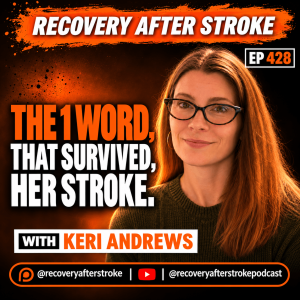
Two weeks after her wedding, Keri Andrews was standing at home chatting with her husband when her body simply gave way. There was no headache and no warning. She tried to grab her arm, and her hand kept dropping, again and again. Her husband called 911 within minutes.
She was 42. Before that day, Keri had built websites at Microsoft, left to launch her own customizable action figure, and pitched it on Shark Tank, where Mark Cuban invested. A month later, she was in a hospital bed, unable to speak and unable to understand anyone who spoke to her.
Keri lives with mixed aphasia. In episode 428 of Recovery After Stroke, she explains what it’s like from the inside, and what she has built since.
What Is Mixed Aphasia?
Aphasia is a language disorder caused by damage to the parts of the brain that handle language, most often after a stroke. It doesn’t affect intelligence. It affects access to words.
Clinicians often describe two broad patterns. In expressive (Broca’s) aphasia, a person mostly understands what is said but struggles to get words out. In receptive (Wernicke’s) aphasia, a person may speak fluently but has trouble understanding language, and their own words may not make sense to others.
Mixed aphasia is when both are affected. Producing language and understanding it are both difficult. Keri describes it simply: her words can get scrambled, and so can her grammar. But, as she puts it, she has a creative mind. That distinction matters. Aphasia takes away words. It does not take away the person.
When Every Language Sounds Foreign
When Keri woke up in hospital, she had no way of knowing what had happened to her. She couldn’t ask, and she couldn’t follow the answers.
“It’s like it changed the channel in like a foreign language and I can’t come back.”
Her own speech sounded like gibberish to her. So did everyone else’s: her friends, her family, her doctors. She says she felt very alone and depressed.
The breakthrough came from a whiteboard. Her husband wrote one word on it: stroke. Keri recognized it. She had once nursed a pet bunny back to health after what may have been a stroke, so the word connected to something she knew. For the first time, she understood why she was there.
Her next thought was hopeful and very human: if it’s a stroke, I can get better and go back to work. It didn’t work like that. Keri never returned to paid work. In the first five months, she had perhaps ten words.
That pace is normal for severe aphasia, and it’s worth saying plainly, because many survivors assume slow means stuck. It doesn’t. Nine years on, Keri is still improving. If you’re living this now, you may find Shannon Nelson’s story of living with aphasia after stroke (https://recoveryafterstroke.com/living-with-aphasia-after-stroke-shannon-nelson/) and our look at an aphasia communication app (https://recoveryafterstroke.com/aphasia-communication-app/) helpful too.
Why Did One Swear Word Survive?
You’d expect that if a stroke wipes out your language, it wipes out all of it. Keri’s first word suggests otherwise.
In hospital, with almost no speech, she tried to say something, anything, and a swear word came out. Her husband jumped up: “Yay, you have a word!” Keri had no idea what she’d said.
This happens often enough that researchers have studied it. Swearing, along with greetings, counting, song lyrics, and other well-worn phrases, belongs to what is called automatic speech. Unlike the sentences we build word by word, these expressions are stored and retrieved more like whole units, and they lean on brain systems tied to emotion and habit, including structures deep in the brain and in the right hemisphere. A stroke that damages the left-hemisphere language network can leave them intact.
That’s why a person with severe aphasia may be unable to name a cup, yet swear clearly when they’re frustrated. It isn’t a personality change. It’s a different route through the brain.
What Caused a Stroke at 42?
Keri’s doctors couldn’t give her a single, certain cause. Two factors came up. She had been having severe migraines every month during the placebo week of her contraceptive pill, and tests found a patent foramen ovale (PFO), a small flap-like opening in the heart that around one in four people have without knowing it.
A PFO can let a clot cross from one side of the heart to the other and travel to the brain. Combined hormonal contraception and migraine are both known to raise stroke risk in some women. For Keri, the doctors’ view was that the pill was likely involved, though nobody could say for certain.
We’ve explored both of these in earlier episodes: PFO and stroke recovery with Yvette Adams (https://recoveryafterstroke.com/pfo-and-stroke-recovery-yvette-adams/) and a link between the contraceptive pill and stroke (https://recoveryafterstroke.com/a-link-between-contraceptive-pill-and-stroke/).
Building Something Without Words
Unable to work and, in her words, extremely bored, Keri picked up puppet patterns and started building. She now has around 30 puppets, including a raccoon named Jimothy, and she gives many of them away to friends.
Her stroke also left her with spasticity and dystonia in her hand and arm. Spasticity is common after stroke (here’s one survivor’s solution for leg spasticity (https://recoveryafterstroke.com/a-successful-solution-to-leg-spasticity/)). Dystonia, in Keri’s case, curled and twisted her fingers, caused repeated sprains and constant pain, and was getting worse as arthritis set in. Years after her stroke, she made a decision about her own body that most people would never consider. How she made it, and how she talks about it now, is one of the most surprising parts of the conversation.
Aphasia Support in Every Language
Much of the aphasia support available is in one language, usually English. Keri saw that gap. After volunteering with the National Aphasia Association, she founded Aphasia Worldwide, a nonprofit focused on research, treatment, and support for people with aphasia in every language.
The site, aphasia-worldwide.org (https://aphasia-worldwide.org), includes information on the types of aphasia, help finding providers and meetups, real survivor stories, guidance for caregivers, and a downloadable aphasia ID card available in many languages. You can hand it to someone so they know you have aphasia and how to communicate with you. The board includes a neurologist.
Where to Go From Here
Of the 428 conversations on this show, Keri’s is one of the clearest reminders that losing language is not the same as losing yourself.
If you’re looking for a practical way to rebuild after stroke, my book, The Unexpected Way That A Stroke Became The Best Thing That Happened (https://recoveryafterstroke.com/book), shares the ten tools that guided my own recovery. And if a stroke has made your world feel smaller, my new book, Your World Doesn’t Have to Stay This Small (https://mybook.to/yourworld), is written for exactly that.
If this show has helped you, you can support it at patreon.com/recoveryafterstroke.
Frequently Asked Questions
What is mixed aphasia?
Mixed aphasia affects both speaking and understanding language. It usually follows damage to more than one language area of the brain, often from a stroke.
Can people with mixed aphasia recover?
Many people improve over months and years, especially with speech therapy. Progress can be slow, as it was for Keri, but improvement can continue long after the first year.
Why can some people with aphasia still swear?
Swearing is a form of automatic speech. It is stored and retrieved differently from ordinary sentences, so it can survive damage to the main language areas.
This blog is for informational purposes only and does not constitute medical advice. Please consult your doctor before making any changes to your health or recovery plan.
Keri Andrews: The Word That Survived and the Life She Built After
One swear word was all Keri Andrews could say after her stroke. What she built next, without words, is the real story.
Highlights:
00:00 The only word she could say
02:22 From Microsoft to Shark Tank
05:47 What causes a stroke at 42?
10:08 Why did that one word survive?
15:22 What if words stop making sense?
20:37 Building something without words
24:30 A decision about her own body
33:48 Help in every language
Transcript:
Keri Andrews (00:00)
I tried to speak. I did have a cuss word.
Um,
Bill Gasiamis (00:04)
which one I
love it
Keri Andrews (00:09)
Yeah. but I didn’t know
I didn’t know what I was trying to s I’m just trying to speak something, just anything. And I my husband, he he just jumped up and he’s like, Yay, you have a word I’m
Bill Gasiamis (00:24)
Quick heads up. You’ll hear a few bleeps in this episode. One of them covers the very first word Kerry said after her stroke,
And why her brain held onto that word says something remarkable about how language works. Hi, I’m Bill Gasiamis and welcome to Recovery After Stroke, episode four hundred and twenty-eight. My guest is Kerry Andrews, founder of Aphasia Worldwide, a nonprofit supporting people with aphasia in every language. Visit aphasia dash worldwide.org or tap the link in the show notes. At forty two, two weeks after her wedding,
A stroke almost took all of Kerry’s language. Years later, she made the decision about her own body that most people would never consider. And how she talks about it now is not what you’d expect. Kerry lives with aphasia. To make the conversation a little easier to follow, I’ve edited some of the restarts and resets that come with it. Everything you hear is Kerry in her own words.
If rehab has finished and you’re wondering what now, I offer one-on-one coaching for stroke survivors. It’s called momentum. Over three months, we meet five times on a video call and you can email me between calls. Together we work out where you are, where you want to be, and the next practical steps. I’ve lived through three brain bleeds and brain surgery. So you’ll have someone in your corner who’s been there.
I’m not a therapist, a doctor, or a rehab provider. This is support built on lived experience. Go to recoveryafterstrokecom/momentum and book your place. Now, here’s Kerry Andrews.
Bill Gasiamis (02:14)
Keri Andrews, welcome to the podcast.
Keri Andrews (02:18)
Hello?
Bill Gasiamis (02:19)
Tell me a little bit about what life was like before the stroke.
Keri Andrews (02:22)
I was
It’s hard to say. I have a lot of hats. I was a website developer at that time. had a job
with Microsoft. and that was that was really um great and welcoming and and my husband actually we met each other at that department and uh
then i quit microsoft because i decided to make a this idea to make a superhero action figure like a customize like in their face and so i did that
And that was just a random thing that I decided to do. Um, I had a couple of founders, uh founders, co-co-founders. so I I I was I was all in for a while. and I went to uh Shark Tank.
uh Mark Cuban he he invested that. so that was really um overwhelming. and uh so I did that and it was a lot of work and time and some things didn’t
make sense anymore. And so I closed my company. and then like two years I had my stroke.
Bill Gasiamis (03:43)
Yeah. So you decided to invent a new action figure that you can customize. And you
Keri Andrews (03:51)
Yeah. Yeah. It’s just
Bill Gasiamis (03:54)
got funded with Mark Cuban. How long was that whole journey? How long did it take to go from funding to finally finishing it up and wrapping it up and ending?
Keri Andrews (04:07)
I had a Kickstarter actually.
and then like two weeks yeah, actually two weeks later I think they found me out for a a producer and no, it had Shark Tank and it was like then then a month later I had to
present on tank. So it was kind of quite a lot. I can show you my my superhero. Here.
Bill Gasiamis (04:33)
Yeah, show me the superhero
Keri Andrews (04:38)
That’s me.
Bill Gasiamis (04:39)
Wow.
Keri Andrews (04:41)
Yeah.
Bill Gasiamis (04:42)
That is very cool. Did the product sell?
Keri Andrews (04:44)
Yeah. I don’t know, just a random thing that I did. Um it had it had 3D printing on that for the f for the faces and I had to like really studying on the faces how how it would move and di distort and all that stuff. Yeah. So that was kind
Bill Gasiamis (05:01)
it eventually make it to market?
Keri Andrews (05:05)
yes. Um uh I had I mean it was just Kickstarter, so it was it was early on, you know. Um it was kind of uh put I can’t pronounce it now. anyway, uh they they they they did they did um buy some of these um items.
Bill Gasiamis (05:27)
Wow. That’s so cool. And then you had a stroke, unfortunately. So tell me about the stroke. What kind of a stroke was it? What type of stroke was
Keri Andrews (05:33)
from my stroke. w what did you say again about that?
Bill Gasiamis (05:37)
it?
Keri Andrews (05:38)
What type of i i have I have mix aphasia. that that means that it can be like Broca’s aphasia or the Wernicke’s um
Bill Gasiamis (05:49)
Wernicke’s
Keri Andrews (05:51)
yeah.
And so I I think I’m kind of a unique situation, you know. I I f I feel. I don’t know. ’cause I I my my words can get strang scrambled for my grammar. Um, but I I have like this creative mind. so yeah.
Bill Gasiamis (06:12)
Okay,
what kind of stroke was it? What caused the stroke?
Keri Andrews (06:17)
I think that I you can’t really say if it’s actually true or not. the doctor said that it would it’s it’s likely was was for uh birth control pills cause for my stroke.
Bill Gasiamis (06:32)
Got it.
Keri Andrews (06:34)
and the doctor s well, I I hadn’t we had a couple other tests. and what happened I think is that
my I had this weird migraines every month and it it was it was because of the the it has this placebo this placebo pills and uh so it’s like
you’d supposed to, start up again for the for the birth control pills. And um so that migraines
Bill Gasiamis (07:06)
.
Keri Andrews (07:08)
was happening um regularly. And um I tried to have other solutions with the do with doctors. I just and so that it was for it was for the um
Yeah. It it’s not aura. It it’s it’s the other it’s the other big throbbing uh uh
Bill Gasiamis (07:30)
Yeah, not aura.
Keri Andrews (07:32)
I mean yeah. Yeah.
Bill Gasiamis (07:33)
Not all right. Okay.
I don’t know the names, but I understand what you’re saying. Yeah. Okay.
Keri Andrews (07:38)
Mm-hmm.
Bill Gasiamis (07:38)
And did the birth control pills make the headaches go away?
Keri Andrews (07:43)
y yeah, so when I I I would have the the migraines it would be like four days. Yeah. And and then it goes away. Um and then when the when the the birth control
pills start up again, then it’s it went away.
Bill Gasiamis (08:04)
Uh-huh.
Keri Andrews (08:04)
Yeah. Yeah. So I
I knew that that was a cause of my birth control pills. I just didn’t I just didn’t I just don’t know. I I felt like it was it was I I don’t know. I just had to figure out maybe a different solution. Um but that’s what I was doing.
But the the the the another doctor or the they tested another t they had other tests and they they showed that my my heart had
a have this flap
And and usually it it’s fine. Um it’s it’s something like like twenty percent or or more that that that that people just have it for their heart and you don’t even know that and so um so I so the doctor saw that.
It ha and they it’s called this PFO. I I can’t pronounce it, but it’s called P P PFO.
Bill Gasiamis (09:14)
Patent
foramen ovale.
Keri Andrews (09:17)
Yes, yeah, yeah. I would not be able to pronounce that at all. But yes. and so it it closed up my heart because this this flap, it was just it’s just like a very very small flap. And it something caused some but you yeah, might have caused that, but you don’t really know for certain if if birth control pills was actually the cause.
Bill Gasiamis (09:44)
Understood. How old were you at the time?
Keri Andrews (09:49)
I was forty two, I believe. Yeah.
Bill Gasiamis (09:52)
Okay.
Keri Andrews (09:53)
Yeah.
Bill Gasiamis (09:54)
And then you ended up in hospital for quite some time. How long were you in hospital for and what other deficits did you have?
Keri Andrews (10:03)
that w that was yeah, it was about a month in the hospital. I yeah, I wasn’t able to speak at all. I I tried to speak. I did have a cuss word. Um,
Bill Gasiamis (10:15)
one which one I love it
Keri Andrews (10:21)
Yeah. but I didn’t know
I didn’t know what I was trying to s I’m just trying to speak something, just anything. And I my husband, he he just jumped up and he’s like, Yay, you have a word I’m like, what are you talking about?
Bill Gasiamis (10:38)
It’s so interesting why I asked you which one, because often people have cuss words that don’t have regular language. And I don’t know why, but my, um, one of my relatives, um, in his eighties passed away after having a brain tumor that was growing over, um, quite a lot of years. And as he started to become more and more impacted by that brain tumor, the only thing that remained from him.
as a human being was cuss words. And the only word that remained was the word And he would
Keri Andrews (11:14)
Mm-hmm. Yeah.
Bill Gasiamis (11:15)
use that for every word for every sentence that he made. And it would just be That was all he could get out. And I remember his wife saying, I’m sorry for his language trying to
kind of explained to me that it was as a result of his brain tumor and the injury that he had. And I’m like, no, I know what it is. Like I totally get it. But he could somehow say the word in about 20 different ways. And you would kind of get an understanding of his experience, how, whether he was frustrated, whether he was happy, you would get a sense of what was going on for him. ah It was so fascinating.
Keri Andrews (12:02)
Yeah. Yeah.
Yeah.
Bill Gasiamis (12:05)
and strange
and bizarre and amazing and sad and
Keri Andrews (12:08)
Yeah.
Bill Gasiamis (12:08)
everything, you name it. It was all wrapped into one. um
Bill Gasiamis (12:12)
Kerry, take me back to the day that it happened.
Keri Andrews (12:15)
Yeah.
I know exactly what happened actually when my stroke happened. I I just got married two weeks bef later and had had my stroke. So um my we were uh newlyweds and
so I I went to um I I had my job uh at my at Microsoft. I had a bus I went to the bus and went to my ho my house and I was just chatting with with my husband and I just kind of stumbled and fell down. I d I didn’t have like a migraine. I just
I just I felt like my my body fell down. And my I remember that my hand oh, by the way, I have this. Oh
Bill Gasiamis (13:10)
we’re going to talk about your hand in a little bit. Yeah.
Keri Andrews (13:15)
bat. yeah. yeah, so my my hand it was just I r I remember that my hand
My my my my body fell down and and my my hand I was surprised and and I I tried to I I tried to the word to to grab s my hand and it would fall down. I’m going back and forth and just fall falling down, falling down.
Bill Gasiamis (13:47)
Your hand was weak.
Keri Andrews (13:49)
Yeah, I I was just like I was just surprised because I I want to grab my arm or something and it just it was just falling down. So and my husband he he saw that immediately and he he he found some some water and he came back to me and he’s like no he he he he called 911 so it was quite quick.
Bill Gasiamis (14:13)
Yeah.
Bill Gasiamis (14:16)
You’re listening to Recovery After Stroke with my guest, Kerry Andrews, founder of Aphasia Worldwide at aphasia-worldwide.org. Whether your stroke was last month or 10 years ago, if you feel like you’ve stalled, I offer one-on-one coaching for stroke survivors. Over three months, we work together on where you want your recovery to go and practical steps to get there. The program is called Momentum.
You can find out more at recoveryafterstrokecom/momentum. Now back to Kerry.
Bill Gasiamis (14:51)
When you woke up and couldn’t speak.
How do you, did you have the capability of understanding that you couldn’t speak or were you confused about it? What was the like?
Keri Andrews (15:01)
No. I
it was just gibberish for myself and for other people that I felt. Yeah. I I didn’t I did not know anything for for for for my friends, family, doctors, nothing.
Bill Gasiamis (15:20)
Do you understand
people speaking to you or not?
Keri Andrews (15:23)
Yeah, it’s just the the the language just
Bill Gasiamis (15:25)
with.
Keri Andrews (15:26)
it just kind of it’s like it just like it it changed the channel in like a foreign language and I can’t come back. You know? Yeah.
Bill Gasiamis (15:35)
There’s no
understanding what they’re saying, no understanding how you’re speaking. Just walk on.
Keri Andrews (15:40)
Yeah. Mm.
Yeah, so I felt like very alone and and depressed. Yeah. Yeah.
Bill Gasiamis (15:48)
Yeah.
And then they put you into rehab. And somehow, you now have speech, it’s been 10 years, but how long did it take for the speech to start coming back where you started to connect what people are saying and had to express yourself?
Keri Andrews (16:05)
It
it was very slow, you know. I I the speech therapists well when the the this at the at the hospital we they did have some speech therapists, and I wasn’t able to speak at all. there was just swelling on on my my brain. So they need to kind of, you know, settle down first. so then um I had a couple of uh speech therapists. Um
And that was at my home. and another one when when they then they you know at h at this home then they they left and I had a different different speech therapist. And um and that was I mean just really slow. Um
Bill Gasiamis (16:49)
Yeah.
Keri Andrews (16:51)
the yeah I didn’t I didn’t know what
my stroke what it was. I was um
the the dark. yeah, it I I wouldn’t be able to speak I didn’t understand what I was saying.
Bill Gasiamis (17:07)
Hmm.
Keri Andrews (17:08)
No, not my words. I wanna I wanna know what happened to me. And I didn’t I just I didn’t know because I wasn’t able to talk t with my my husband, you know, and he he he he knows what happened, but I just I I was I was una unaware.
And I my and he he showed me a a whiteboard to so I can kind of have some kind of like to to to draw or something. But he he wrote it down uh stroke and I actually recognized that.
That that’s like oh, that’s what it was.
Bill Gasiamis (17:53)
Okay, so that was the first time you understood why you were in the situation you were in.
Keri Andrews (17:59)
Yeah. Yeah. And I remember that my my uh I I remember that a bunny had a stroke or perhaps a mi a really bad heat stroke. I don’t know what that is, but I think that a a bunny had some kind of a stroke and and I remember that I was
trying to help my bunny and you know I had her food and water and everything and then she it was it was about maybe maybe four weeks later he kind of she kind of started to move around with his with her her movement.
Yeah.
Bill Gasiamis (18:49)
So you
understood from that experience
Keri Andrews (18:52)
Yeah.
Bill Gasiamis (18:53)
what had happened to you.
Keri Andrews (18:55)
Yeah, because I didn’t know I mean I I know about strokes, but I don’t know who they who people I don’t know who they are. I
Bill Gasiamis (19:03)
Yeah.
Keri Andrews (19:03)
don’t I don’t know if that what that entails. And
Bill Gasiamis (19:06)
Yeah, we connected the dots for the first time.
Keri Andrews (19:10)
Yeah, and I thought, I I can get better because I have a stroke and I can be I can go back to work, right?
No, it doesn’t work like that. No. I thought it would work. I thought I’d be able to ha you know, go back to my work, but it it just no.
Bill Gasiamis (19:35)
Home.
Keri Andrews (19:33)
I never got back to work. I never n I never have a job.
I had maybe um maybe ten words in about five months. It was very slow. Yeah. Yeah, I had had more and more, but
Bill Gasiamis (19:50)
Fair enough. um
Keri Andrews (19:54)
it’s been you know, it’s been progressing. Yeah. Or no, it’s getting better.
Bill Gasiamis (19:56)
Yeah. Getting better and better still.
Keri Andrews (20:00)
Yeah, yeah, yeah.
Bill Gasiamis (20:01)
Great. Then you didn’t go back to work, but you did pick up some new skills or you developed some new things and behind you, I see your family there. Tell me about how
Keri Andrews (20:12)
Yeah.
Bill Gasiamis (20:15)
you started to make puppets. What, what is that all about?
Keri Andrews (20:19)
Yeah, I I made I have some patterns. I I just I was just curious what I build just to build something. I was just extremely bored and I wasn’t able to speak at all. So I I kind of picked it up on some patterns and yeah. Ta da.
Bill Gasiamis (20:42)
Yeah. Can you bring one of your puppets down?
Keri Andrews (20:45)
Yeah.
Bill Gasiamis (20:55)
Who’s Jimothy. Tell me about, hello
Keri Andrews (20:56)
This is Jimothy. Yes. Hello.
Bill Gasiamis (21:01)
Jimothy. Tell me about Jimothy. What do you do Jimothy?
Keri Andrews (21:05)
I don’t know. I I I can’t really pronounce I can’t per perform, but I just I just like to make puppets. Yeah.
Bill Gasiamis (21:15)
Yeah. And can people
buy your patterns and make the puppets at home themselves?
Keri Andrews (21:20)
yes, yeah. Uh huh. Yeah.
Bill Gasiamis (21:22)
huh. And what
kind of animal is Jimothy?
Keri Andrews (21:27)
this is this is Jimothy.
Bill Gasiamis (21:28)
or Jimothy.
Keri Andrews (21:29)
Um yes, Jimothy. you see his there’s no neck.
that that that’s this is do you do you know what Jimothy it is? That this is okay, Jimothy is boy. there is a raccoon who lives there.
in Seattle and and this is has some kind of a d disform dis dysformant dys dysformant dys disform
Bill Gasiamis (22:00)
deformity, deformity.
Keri Andrews (22:01)
yes mm-hmm and and they and they can just kind of like they the the the raccoons they were like playing it was just really funny and so it was like it had this big viral
raccoon and in in in seattle right now my god people people love this particular um raccoon and they they they have all these they have all these paintings all this uh
dolls or whatever like that. It’s just kind of funny. And and actually one of the one of the painting this this one particular painting is is called uh Henry Henry um they they had um they had it up in the auction and they had there was the the painting and and someone
bid something like a uh I maybe it’s probab now I think it’s probably about a a million dollars. Like seriously for Jimothy.
Bill Gasiamis (23:17)
for a painting.
Keri Andrews (23:19)
Yeah for Jimothy for for Jim because people love Jimothy. It’s just kind of wild.
Bill Gasiamis (23:25)
It’s wild.
Keri Andrews (23:26)
for this puppet, uh well this is my
Bill Gasiamis (23:26)
Which one is your favourite puppet?
Keri Andrews (23:29)
my favorite puppet. This is this is Jimothy.
Bill Gasiamis (23:31)
Now do
you sew those? you put those, cut them up and turn them into puppets from fabric?
Keri Andrews (23:38)
yes, I have I have some I have a lot of patterns and a lot of foam and
Fur and all that stuff, yeah. Yeah.
Bill Gasiamis (23:48)
Kerry, for people listening rather than watching after the stroke, you had your arm amputated.
Bill Gasiamis (23:54)
earlier you showed me your arm. You told me your arm.
Keri Andrews (23:57)
Yes.
Bill Gasiamis (23:58)
That one there is a little shorter than the other one. What happened to your arm?
Keri Andrews (24:02)
Yeah, yes. Yeah. I I I felt like I feel like like Jimothy, I I I have uh disability myself for myself. I have I had my I had some complications with my arm from my stroke.
I had I have spasticity and dystonia. spasticity is very common for strokes. you know their their arms can be or or their legs can be really tight. and
and just up here or up here. Um but I’m actually okay. but the other thing is that the so the dyst dystonia is um very strong.
And so it would distort fingers like is this like all like weird and and it would it would it it’s it’s kind of like the words
I can’t pronounce this. the it like my my fingers was constantly hurting and it’s not like I broke my fingers, it’s the other one. like a sprain no, a sprain? Yeah.
Bill Gasiamis (25:20)
Mm-hmm.
Keri Andrews (25:21)
Yeah. It I had a couple of sprains and I wasn’t able to fix anything.
Yeah, so I had yes and
Bill Gasiamis (25:31)
And it was very painful all the time.
Keri Andrews (25:34)
it was getting even worse. Yeah. So um ’cause my I had I had some arthritis
Bill Gasiamis (25:42)
Uh-huh.
Keri Andrews (25:44)
and it was getting really bad. so my fingers are starting to get really weird.
and it was going to it was gonna get a lot worse. I knew that that was gonna be it was gonna be really weird because my fingers were can’t the can’t control my fingers
and and it would just kind of like it kind of like curls up the fingers and I’m just like boy, the the
arthritis is gonna get that’s gonna start having some weird weird things to start having like
so distorted and I’m like, That would mean that if I don’t have an amputation, um I would have to have like pain management forever. You know, and it’d get even worse and worse and worse. And
Bill Gasiamis (26:39)
Understood.
Keri Andrews (26:40)
I’m like, I don’t want to deal with that. I can’t even handle that. Um
And just I would just be I would be able to go out, I would be able to hang out. I wouldn’t be able to like to work or anything. I don’t not really to work, but it’s different. and yeah, I just I I was being very um I was very assistant to have an amputation. And I had a amputation party.
to you know, to remove my my pain. Yeah. So I mean it didn’t you know, my my pain isn’t necessarily gonna be it’s it’s not like cured or anything. It just I’m just gonna have pain regardless. But it but it’s but it’s relief. It’s much better.
Bill Gasiamis (27:36)
It’s r
it’s it’s relief. So it has improved the quality of your life.
Keri Andrews (27:40)
Yeah, yeah, definitely.
Bill Gasiamis (27:42)
So you’re not the first person who I’ve spoken to who had an amputation to improve their quality of life. One of my earlier stroke survivors, a lady had a similar problem with her foot, and she had a foot amputated, and that improved the quality of her life.
And it went from being completely painful and causing a lot of challenges to being pain free. And the prosthetic made her life able to be walk again, get around, do all the things that she had done before. And it seems to be a dramatic solution, but a very useful solution. Would you have thought about
Amputation as being the solution? Did somebody offer it to you? How did you get to that
Keri Andrews (28:31)
I
Bill Gasiamis (28:31)
outcome?
Keri Andrews (28:32)
I just had to. Um, if I didn’t have an amputation, I had some other um different ideas. Yeah. Yeah. Yeah, it was pretty serious. Yeah.
Bill Gasiamis (28:41)
Aha. I th I think I know where that’s going. Pretty dark. Okay.
Keri Andrews (28:48)
Yeah.
Bill Gasiamis (28:50)
That’s so res that that resolved that issue.
Keri Andrews (28:53)
Yeah, yeah. I feel it’s it’s much better, stronger, and I’m just yeah, that’s what I have.
Bill Gasiamis (29:04)
That’s amazing. It’s so good that that got you such a good outcome. And you seem so comfortable about it. It doesn’t really seem to bother you at all that you had your arm amputated.
Keri Andrews (29:14)
I actually think it’s it i I think it’s kind of funny, you know. Um I I had you know, I have I joke about this this this movie this movie called Evil Dead 2. Um, you know who that is. Uh
Bill Gasiamis (29:30)
I know that is
Keri Andrews (29:31)
yeah, so that that i a lot it’s a c class it’s a cult
classic
Bill Gasiamis (29:37)
same
Keri Andrews (29:38)
and they they would the the it would the it’s basically like a zombie attacked a human and it tried to um bite on the arm and the the the the main character Ash
he he saw that the the arm is going to start to go go worse and is gonna start to have they’re gonna have they’re gonna have to have um to have like actually another zombie or something. And so they chopped off the hand and actually before that the the the this chop the the the hand was starting to attack himself.
like this. That’s like a fa that’s like dist this disonia. Yeah. It feels like it’s it’s it’s it’s not like that bad, but it’s it’s but I I feel I feel it’s funny. And um so so then the the of course the the main character he you know he chopped off the arm and he replaced a chainsaw.
Has this new chainsaw. I actually have a chainsaw f for cosplay stuff. Yeah. Yeah. Mm-hmm. Yeah, yeah. So I I think it’s kind of funny. yeah, yeah.
Bill Gasiamis (30:58)
A cha for your hand inst a chainsaw instead of your arm. I love it. I love it. I love
that you can spin it that way and make it something
that you can laugh about. It’s so fantastic that you can do that.
Keri Andrews (31:12)
Yeah. Yeah.
Bill Gasiamis (31:15)
and and it’s like getting rid of the arm in Evil Dead 2 is kind of saving the person. It’s like you have to stop that the the bite from spreading to the rest of the person and turning them into a zombie. So the solution was to remove the arm and then replace
Keri Andrews (31:30)
Yeah. Yeah. Yeah.
Bill Gasiamis (31:34)
it with the chainsaw to fight the zombies.
Keri Andrews (31:36)
Yeah, yeah. I actually went to see Bruce Campbell at Comic Con and I and I I had a letter to him and he he saw that. He’s like do I need a sign or something Okay, whatever. Um I I had uh on Comic Con I also called I I also saw
on a puppet there’s a there’s a puppet hold a second Adam Savage he he he’s he’s from Mythbusters and they they that’s that’s why that’s why he made a puppet he had a had a puppet
on the video from my so my husband found this out and that’s that’s why I think that I think that’s cool and that’s why I started to make a puppet and so I had a a letter to uh Adam and and he he almost tr cried. Yeah. So that was a very special moment. Yeah. Yeah.
Bill Gasiamis (32:42)
Yeah. Fantastic.
so what’s the plan with the puppet family? Is it going to get bigger? ‘Cause there how many are there now?
Keri Andrews (32:51)
it’s probably about I don’t know, maybe thirty puppets or something like that.
Bill Gasiamis (32:55)
Mm-hmm.
Keri Andrews (32:56)
I didn’t really sell puppets that much. I basically I I I would give some of my friends for their for for their their pup for puppets and stuff. Um
Bill Gasiamis (33:08)
Yeah.
Keri Andrews (33:08)
that’s because trying to
Be positive thinking and stuff. Yeah.
Bill Gasiamis (33:12)
Yeah. That’s lovely.
And also you you have a website, you started a website, aphasia-worldwide.org. Tell me about that story.
Keri Andrews (33:21)
Yes, yes. That’s a there’s a different story, yes. Um
Yes, so I had some ideas. I I’m very I’m very involved about aphasia organi with organizations. and I would I was a volunteer with aphasia.org.
um that’s in a in actual in national aphasia associ association I was I was a volunteer and I was I was working on that and
I I felt like something was a little bit different from what what their um their idea and I have a different idea. And so I so I started to pivot and I had a new nonprofit called Aphasia Worldwide. And it’s been a year. Um and and so
The website is it’s for it’s it’s largely for um research treatment and support. so that that’s what I want to focus on. Um yeah.
Bill Gasiamis (34:37)
Yep. I
see here you put your website skills to good use because you built a great website. And at the top of the website there are some buttons and one of them says learn and it gives information about what is aphasia.
The types of aphasia, aphasia facts, questions about aphasia, etc. Then there is the recovery and therapy tab where it helps people find aphasia providers, rehabilitation and recovery timelines, talks about timelines. Then there’s stories with real aphasia stories and people who have spoken about their stories, and you are encouraging people to submit their story.
Keri Andrews (35:18)
Yes.
Bill Gasiamis (35:19)
Then you have aphasia meetups. You help people find aphasia meetups, which is amazing
Keri Andrews (35:23)
Yes. Yes.
Bill Gasiamis (35:25)
because people will feel isolated with aphasia.
Keri Andrews (35:28)
Yes.
Bill Gasiamis (35:28)
And if they can get together with other people, that makes it a little better.
Keri Andrews (35:33)
Mm-hmm.
Bill Gasiamis (35:34)
And then you have an amazing tab, which is Caregivers Need to Know.
Keri Andrews (35:39)
Mm-hmm.
Bill Gasiamis (35:39)
That’s brilliant. I think that’s amazing because that’s exactly what it is. Caregivers need to.
learn what aphasia is like and not assume and and not judge, etc. And it’s very hard at the beginning. Then there is an aphasia ID card where somebody can generate a card, give that to somebody else and say
Keri Andrews (36:01)
Well
for all for all these l for almost all languages they can they can Yes.
Bill Gasiamis (36:07)
Are fabulous.
Keri Andrews (36:10)
Mm-hmm.
Bill Gasiamis (36:10)
Fabulous. You can just click there, download the PDF, and that person
Keri Andrews (36:13)
Yes. Yes.
Bill Gasiamis (36:15)
then knows that the person in front of them
Keri Andrews (36:18)
Mm-hmm.
Bill Gasiamis (36:18)
has aphasia and that they need to have a the conversation in a different way, perhaps. then there’s a little bit of information about and the leadership team and the media kit, and then there’s ways to help people can volunteer. They can donate.
And I’m gonna click on the leadership team because the leadership team isn’t just you, Keri. it is some other amazing people that have also joined the the cause. And you’ve got a vice chair, you’ve got a treasurer, you’ve got a secretary. This is a proper charitable organization.
Keri Andrews (36:54)
Yeah. They are very good.
They are very the board members are very, very good.
Bill Gasiamis (37:00)
Yeah.
Keri Andrews (37:01)
Yes. Yeah have you have a a neurologist, yeah have yeah, it’s like yeah, it’s pretty legit.
Bill Gasiamis (37:08)
Yeah, legit properly. so it’s supported by some amazing people and this was your idea. It was to try and create more awareness and more support of people that are experiencing and living with aphasia.
Keri Andrews (37:22)
Yeah, yes. Yeah. I know that a lot of people, um I I feel like some some countries are focusing on their own their d only in the f only on their their their language, one language. That’s English, usually. and and it’s it’s really it’s I kind of think this is a really s small center.
And I felt I want to broad so that because other people they don’t other people are unaware of what aphasia it is, especially of other languages. So that that’s why I wanted to um have this you know show support.
For all? Yeah.
Bill Gasiamis (38:14)
That’s a great idea and a big job. Lots of people.
Keri Andrews (38:16)
Yes it is.
Bill Gasiamis (38:17)
Different languages. Gosh, what a challenge. I love that you’ve taken on this massive challenge. It doesn’t seem like you’re afraid of a challenge. you had to overcome the challenge of aphasia yourself.
you came up with a very amazing solution. Um you had a a amputation party, which is just fantastic that you would take that type of attitude into such a serious surgery. Um you’re not afraid of doing what’s tough. And that’s that’s a great trait to have, especially when um
You’re challenged with things you couldn’t imagine yourself being challenged with before the stroke, having your arm amputated would never have been in anybody’s thoughts that would potentially one day be a solution to a difficult problem.
The website is aphasia-worldwide.org. I’m gonna have the links in the show notes in the description. People can reach out to you via there. I will promote that at the beginning of the podcast episode and we’ll talk about trying to get people to uh reach out and connect with you guys.
Keri Andrews (39:31)
Yeah, that’s great.
Bill Gasiamis (39:32)
I appreciate your time. Thank you so much for reaching out and it was lovely to meet you.
and get to learn your story and and share the things that you’ve overcome.
Keri Andrews (39:42)
Yeah, great. Thank you so much.
Bill Gasiamis (39:44)
Well, that was my episode with Kerry Andrews and a massive thank you for joining me on the podcast. What stays with me from this conversation is how Kerry keeps building something. When her words were gone, she built puppets. When
Pain was taking over her life, she made a hard decision and found humor in it. And when she saw how few people understand aphasia, especially outside English, she built Aphasia Worldwide. If you or someone you know lives with Aphasia, visit aphasia-worldwide.org, download the Aphasia ID card, find a meetup, share your story, and if you can, volunteer or donate.
If part of this episode touched on something you’re carrying right now, please reach out to someone today. In the US, call or text 988. In the UK, call Samaritans on 116123. In Australia, call Lifeline on 131114. These numbers are in the show notes too. And if you’re ready for someone in your corner while you rebuild,
Momentum is my three-month one-on-one coaching program for stroke survivors. Go to recoveryafterstroke.com/momentum and book your place. I’m not a therapist. I’m not a doctor or a rehabilitation provider. This is support built on lived experience alongside the care you already have.
Think of one person who needs to hear Kerry’s story. It might be someone with aphasia, a caregiver, a speech pathologist. Send them this episode now. Remember to subscribe so you don’t miss the next conversation. I’m Bill Gasiamis. Thanks for listening and I’ll see you next time.