Aphasia Communication App: How One Brother Gave a Stroke Survivor His Voice Back
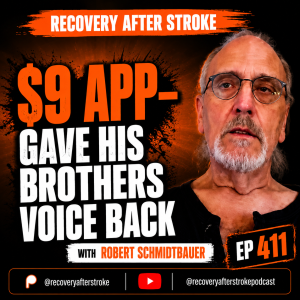
For four or five hours, Robert Schmidtbauer’s younger brother lay on the floor of their Wisconsin home, unable to get himself up. Robert found him when he got home from a late shift driving cabs. His brother had been drinking that night, but this wasn’t alcohol; it was a stroke, one that would put him in the University of Wisconsin Hospital for three weeks and in rehab for six months.
His brother was already living with ataxia, a rare progressive condition that had taken his ability to walk and had begun to affect his speech. The stroke made it dramatically worse. Today, unless you know him well, you’ll understand only 60 to 70 percent of what he says. It’s usually the end of a sentence, the last few words, the part that carries the point that disappears.
Robert became the translator. For years, every visitor, every relative, every tradesperson needed him in the room to fill in the blanks. Then he built something better: an aphasia communication app called Larry’s Speakeasy, priced at nine dollars for life, now used by people in 20 countries.
When the Speech Problem Has No Official Name
One detail of this story will be familiar to many stroke families: Robert’s brother has never been formally diagnosed with aphasia. The doctors attributed his speech difficulties to the combination of ataxia and stroke and left it there. After a year of speech therapy and his own reading, Robert concluded there was “probably some of that in there,” but no clinician ever gave the problem a name.
That matters, because a diagnosis is often the doorway to resources. Without one, nobody hands you a communication aid, a device funding pathway, or even a list of options. Robert’s brother got speech therapy two or three hours a week while it lasted, some practice phrases to take home, and nothing else.
The Gap Nobody Warns Stroke Families About
Rehab ends. The communication problem doesn’t.
When Robert’s brother came home, the brothers developed their own system: Robert would catch 90 percent of a sentence, ask him to repeat the rest up to three times, and then ask him to spell the words letter by letter. That was the system for years. Robert credits his stint teaching English online to students around the world for training his ear to listen closely.
But the system only worked when Robert was in the room. The moment that changed everything was ordinary: a new housekeeper came to quote on cleaning, and Robert’s brother, who runs the inside of the house, couldn’t make himself understood on the details. Robert stood in the middle, finishing sentences. He’d felt like a “third wheel” through his brother’s rehab, looking for a way to genuinely help. Standing in that kitchen, he found it.
“I had one person on my wing that no one else in the building could understand but me. And even I had a 50% chance of understanding what he really wanted.” — a care facility director, on why a tool like this matters
What Is an Aphasia Communication App?
An aphasia communication app is software that speaks for a person whose own speech is impaired a modern, affordable form of what clinicians call AAC (augmentative and alternative communication). Larry’s Speakeasy does two things, deliberately kept simple:
Type-to-speak. If your hands still work, you type any phrase or sentence, and the app says it out loud.
One-tap phrases. For people with limited hand function, pre-made buttons cover emergencies (“I need to go to the bathroom,” “call the doctor”) and everyday phrases hello, goodbye, and a growing list Robert adds to as users suggest them.
The market Robert walked into explains why he built his own. At the affordable end, there’s roughly one comparable app at around $13. After that, the next step up starts near $150 and climbs to $7,000–$8,000 for dedicated equipment that requires training and support to operate. Between a cup-of-coffee app and a small car’s worth of hardware, there was almost nothing.
Robert priced Larry’s Speakeasy at $8.99 once, for life. “It’s not here for me to get rich off of,” he says. “It’s my brother, and I want it to help.”
Built With AI, in Days, by a Retiree
Robert is 67, with a background in television and radio rather than software. He’d spent months learning to work with AI tools and, in his words, cussing and swearing at the computer. When the housekeeper moment landed, he posed a different question to the AI: how can I help my brother’s speech? And had a working version running within about two or three days, refined over the following months.
That’s worth pausing on. The tools to solve a real disability problem at kitchen-table scale now exist for people who aren’t programmers. A determined care partner built, tested, and shipped an aphasia communication app from rural Wisconsin no company, no funding, no advertising. Around 260 people across 20 countries have tried it, and it’s listed as a resource on the National Aphasia Association website.
More Than an Emergency Button
The use cases stretch well beyond the kitchen:
Therapy practice. Practice phrases from a speech pathologist can be loaded into the app and drilled at home with or without a partner.
Video calls. Open the app in one window and Zoom or FaceTime in another, and a person who can’t speak clearly can hold a conversation with family anywhere in the world. Robert saw his own mother’s isolation in a care facility years ago; this is his answer to it.
Care facilities. An iPad on a care cart could let staff understand residents nobody else can and document requests, which protects residents and facilities alike.
Where to Find It
The app lives at LarrySpeakeasy.com, with a seven-day free trial before the one-time $8.99 purchase. Try it, and if it helps, it helps, as Robert puts it; there’s no push.
Stories like Robert’s are why this podcast exists: ordinary people refusing to accept the gap between what the system provides and what recovery actually needs.
If that resonates, my book, The Unexpected Way That A Stroke Became The Best Thing That Happened, shares ten tools for recovery and personal transformation drawn from my own stroke journey and hundreds of survivor interviews; you’ll find it at https://recoveryafterstroke.com/book. And if this show has helped you, you can support it at https://patreon.com/recoveryafterstroke.
This blog is for informational purposes only and does not constitute medical advice. Please consult your doctor before making any changes to your health or recovery plan.
Robert Schmidtbauer – Building a Voice for My Brother (Interview)
After a stroke, Robert’s brother lost clear speech and had no tools to cope. So Robert built one: a simple app that speaks for those who can’t.
Highlights:
00:00 Introduction – Aphasia Communication App
01:21 Challenges in Communication Post-Stroke
05:17 Stroke Experience and Recovery
12:20 Communication Challenges and Solutions
17:43 Creating Solutions Through AI
18:03 Introducing the Aphasia Communication App
21:13 Expanding Accessibility in Care Facilities
27:14 Final Thoughts and Resources
29:19 Bridging Communication Gaps
30:14 Resources for Stroke Survivors
Transcript:
Introduction – Aphasia Communication App
Robert (00:00)
If I ask him three times, I still can’t understand it. Like, spell it for me. You know, so I mean, that’s kind of how we got by until I developed this app.
Lacunar Stroke New Research (00:10)
Hello, everyone, and welcome to another episode of the Recovery After Stroke Podcast. Before we get into it today, I want to say a massive thank you to all my Patreon supporters and to everyone who supports this podcast. You are the reason this show keeps going. And I appreciate every single one of you. If you’d like to help keep these episodes coming, you can support the show at patreon.com/slash recovery after stroke. And if you’re looking for tools to guide you,
On your own recovery, my book, The Unexpected Way that a Stroke Became, the best thing that happened, is available at recovery after stroke.com slash book. Now, today’s episode is a little different. My guest is Robert Schmidtbauer. And Robert is not a stroke survivor, he’s a
care partner. His younger brother was already living with ataxia, a rare condition affecting his muscles and speech, when a stroke six or seven years ago made communication between the two brothers harder than it had ever been. In this conversation, we talk about what it’s like to be the person who translates for someone you love, what happens when rehab ends
and the communication problem doesn’t? And what Robert decided to do about it. Something that might genuinely help other families in the same situation.
Challenges in Communication Post-Stroke
BIll Gasiamis (01:30)
Robert Schmidtbauer welcome to the podcast.
Robert (01:33)
Thank
BIll Gasiamis (01:33)
can you give me a little bit of a rundown on you and your relationship with your brother before he had a stroke?
Robert (01:42)
My brother’s nine years younger than I am, so he’s 56, no, 58 now. And we’ve been living here. He originally got out of high school, went to travel school in Minneapolis, Minnesota, and lived there for a number of years. He has a taxia, and he moved home.
to my mother’s house. Let’s see, we’ve been here 16 years now in this house living together. And he moved home about 20 years ago. Not quite, maybe like 18, 18 and a half. The ataxia took away his ability to walk. I’m not sure if you’re familiar with ataxia, but it’s kind of like in the muscular dystrophy realm. And it’s very, very, very rare.
he attacks your muscles. depending on the seriousness and the kind, there’s like 20 different kinds. You probably wind up dying from it because it slowly affects your muscles. And the first things to go usually are your extremities. In his case, it was his legs and his speech. So when he moved home, he already
had a slight problem talking, not real bad, but my mother built a house and it was very small, just one level.
so that she didn’t really have to walk up and down stairs and that type of thing. And so he was basically sleeping in the easy chair when he moved back home. And I lived across the street. So I said, come on and move in with me, because I’ve got this big house. I was a single parent at the time. I have one son. And I said, there’s plenty of room here. You can have a bedroom and live here.
Stroke Experience and Recovery
And so we lived here. The story behind him and the stroke, I was at the time working as a cab driver at a resort town north of here.
And so I would never usually get home on weekends until like four or five in the morning. And I came home, I found him on the floor. And so he had a drinking problem at that time. And I asked him what was wrong. And he said, well, I’m drunk. I well, how long have you been here? he’d been on the floor for like four or five hours.
My brother is probably 6’1″, or around 6’2″, 230, 240. I couldn’t lift him up. We bought this house as a duplex. My girlfriend at that time lived and rented from us a basement apartment. Even with the both of us, we couldn’t.
get him up. So called the ambulance, we got him in and it obviously wasn’t alcohol, although he had been drinking. He wound up going to, we live in the state of Wisconsin and Madison is in the south part of the state, which is our state capital. They took him to the hospital here and then they flew him to Madison and he wound up
there in the University of Wisconsin Hospital, which is a very big progressive type hospital. And he was there, I think about three weeks before he came back to a nursing home here to recover. And so his recovery before he finally got home, I would say, going back to memory, we never really wrote it down, but probably about six months. He was in the nursing home for a good
three, four months and then in an assisted living type situation where he had his own room, didn’t have to share it, was going through treatment and rehabilitation before he got home. And so then he came and when he was done with that, then he moved back here. So was about a six month process.
BIll Gasiamis (05:37)
How long ago was a stroke?
Robert (05:40)
exactly. I couldn’t tell you to be honest Bill, but somewhere in the realm of six to seven years. I go back, I ran a bar at one time and I’ve been gone from there for four years and this was before that. So I would say between six and seven years ago.
BIll Gasiamis (05:57)
Before COVID.
Robert (05:59)
Yeah, before COVID.
BIll Gasiamis (06:01)
Okay. So when he came back from rehab and the assisted living and came to live at your house, what kind of deficits was he living with?
Robert (06:13)
Excuse me. He still couldn’t walk. He was already in a wheelchair at that time with a taxia. And that didn’t really change much. was worse, obviously, when he first had the stroke, but the rehab helped him to get back to, I would say more or less where he was before the stroke. As far as being ambulatory, he can still stand up. He can still…
function, get into counters and cupboards and things like that. He just, the legs, he just can’t walk. He could crawl on the floor if he had to. And his arms and everything still work, so he could still type. again, this was through rehab, but he pretty much got back to where he was prior to that, except for the speech.
the speech became noticeably worse. I would say even at this time, at that time it was really bad, at this time unless you know him and live with him or have known him previously, you’re probably going to understand somewhere between 60 and 70 percent. It’s usually the last part of a sentence or thought is what
Most people have difficulty understanding.
BIll Gasiamis (07:30)
So is it the ataxia and aphasia that he’s dealing with?
Robert (07:34)
You know, officially he’s never been diagnosed with aphasia. It’s probably more to do with the ataxia combination with the stroke. So the doctor has never really the prognosis or whatever you want to call it. They never really diagnosed them as having aphasia. But after reading up on it and going through therapies,
you know, for speech and other things. And that continued for the better part of a year. It’s kind of obvious that there’s probably some of that in there. But as far as a medical diagnosis, official medical diagnosis, we never really got that meaning from any of the doctors.
BIll Gasiamis (08:17)
Got it. So he came back, he would have had some needs f and you would have had to support him with those, if obviously the walking and then and then whatever other needs. So in that communication early on, were you guys able to actually communicate and you understand what his needs were and help him with what he was asking?
Robert (08:40)
Yes, there was a point and you being a strokes arrival, you know, I have no idea. have AFib and so, you know, kind of runs in our family. So I knew some of what he was going through, but obviously I don’t know what anybody who’s had strokes, you know, have to go through on a daily basis. watching him, there was a point, especially in the nursing home immediately after in the first several months.
I would say that there was major depression. There was a battle. I often quote a movie. There was a line that black actor, what was his name? Older guy that played God. Anyway, came on said one time, you never get busy living or you get busy dying. And so I mean, there came a point.
after like the first month where we kind of had a come to Jesus conversation at the nursing home and it was like, okay, because he wasn’t following their recommendations too much. didn’t really, the therapy and stuff, wasn’t too thrilled and excited to do that. so I mean, through this conversation, it was like, okay, like, look, you know, either.
You try and make the best of the situation and improve or I can’t help you. It’s like alcoholism or any other drug disease. You really have to want to do it, I think, yourself.
And so he’s been dry now for, boy, well, since the stroke, probably close to 10 years now. I mean, he slowed down enough after the stroke, he quit completely. But so, yeah. So I mean, that, you know, the communication.
I could communicate with him in hospital. It was harder, obviously, but, you know, I could still understand him. The one thing that helped me out throughout the period that we lived together, especially after the stroke, was I taught English online. So I talked to people from Saudi Arabia. I talked to people, you know.
from various countries around the world. And that really helped me because I had to listen closely to them. But there are still times where I will ask him, I get 90 % of it and we get to the last couple of words and I’ve got the gist of it, but it’s like, I don’t understand the last words.
He’s come out like, okay, ask me three times. If I ask him three times, I still can’t understand it. Like, spell it for me. You know, so I mean, that’s kind of how we got by until I developed this app.
BIll Gasiamis (11:23)
Yeah. And it it’s interesting, like you guys all went through rehab, left from hospital, came home, he had a speech issue, and yet you guys didn’t weren’t given a tool or something to help you guys communicate at all. It wasn’t even like a thought for anybody to do that.
Robert (11:45)
No, there was not. I mean, he had speech therapy when he went to the hospital, but that was an hour, three times a week or two times a week. I mean, it wasn’t an everyday type of thing. So yeah. then exercise is when he came home from there that he would, know, phrases and words and stuff that the therapist would want him to practice at home. And even that was…
somewhat of a struggle, because we’re kind of, no disrespect to nationalities, but we’re kind of pigheaded Germans.
Communication Challenges and Solutions
BIll Gasiamis (12:20)
that being said, you come home, you haven’t got the tools, you’re trying to help.
your brother, there is times where you can’t understand what he’s saying. And you think, I know, I’ll create my own solution for this problem. And tell me about th the background that you had that helped you solve that problem and the solution that you created.
Robert (12:43)
Yeah, well, if we go back to, you know, when he came home, because this is obviously been recent, right? It’s because of my background was in television and communications. I worked in television and radio. And so I enjoyed playing with computers when he came home because, you know, we were fairly close family and knew him. I just let him do his thing.
you know, and if he asks for help whenever I was there for him. But I always felt like a third wheel going through, you know, the stuff from him, his his rehab. I take him there and do it, but there wasn’t much except for like the speech stuff to help him be repetitive on that. So it felt like kind of a third wheel. So it kind of settled into
a pattern, you know, unless he needed help, he’s pretty self sufficient. He has a CNA that comes over a couple times a week to make sure that like, when he takes a shower, he doesn’t fall, you know, that that kind of stuff helps with the dishes or cooks a couple meals and puts it in the refrigerator. But I was looking for ways, you know, and trying to think of what a person could do.
Creating Solutions Through AI
Well, So I still work, you know, part time. And through television, I had my own production company and did things on the side all the time. And so I like to be creative. And
a friend of mine who lives in Chicago had a business and we started playing around with AI for about the last six months now. And it’s not as easy as some people say it is, you know, and especially to learn how to use it.
So we started playing around with it. And the frustration level of learning AI got to me after we were into it two or three months.
you know, learning how to prop things and explain things to get the result that you wanted, I think is one of the biggest keys for that. And not to go off on a tangent here, but this is how the app and working for my brother really came about. I just needed a break. So it came to a point where I’m cussing and swearing.
swearing back at the computer and AI and I’m like, no, no, no, no, we tried to do this like five times. This is really simple. You just change this one thing and you’ve got what I want. But every time I asked it, would change something else. And so I’m like, OK, I still want to continue to learn how to use AI, but I got to just put that aside for a minute and take a day off and not work on that. And so we happened
I’ve had, I was a single parent. My son was 13 months when my ex-wife left. And so I raised them by myself. And I’ve had a housekeeper that’s been with me for like 20 years. And she is getting older. She’s like in her late 60s, early 70s now. She fell and she busted her hip. And so we had to find another housekeeper while she was recovering. You know, I said, if you want to come back, you’re more than welcome to, but you know, we’ll find someone else in the meantime.
And so we had someone come over to the house and give us a quote on what it would cost us to just tidy up the kitchen and the bathrooms and stuff, because I still work about 30 to 35 hours a week. the same thing that happens over and over again when people and relatives visit us with his speech happened with her. And when I’m around, I’m the go-between.
I mean, it’s kind of they understand the 60 % of the first part of his answer. And because he’s around the house all the time and doesn’t leave it, I leave those kind of decisions that I take care of the outside and the lawn and those things that I leave the inside of the house to what he wants. Because he’s the one that spends most of the time, you know, in here. And so I’m answering, you know, I’m filling in the blanks for her. You she’s like, okay.
I understand you want the bathroom clean this way, but what was that last part? And so I finished the sentence. I’m like, well, he said this, you know? And it kind of dawned on me at that time, you know, going back to the third wheel feeling, kind of dawned on me at that time. I’m like, okay, what if I asked AI a couple of questions about how I can help him, you know? I mean, and help him with his speech.
And that’s basically how the app came about. She gave us a quote that was here for half hour, and that happened half a dozen times. And so after she left, I’m like, all right, I still want to try and continue to learn this. And maybe by doing a different project that I’m not just completely frustrated with at the moment, I can help myself with this other project and help him all at the same time. And so.
I just posed the question to you, I use Claude mostly, and I just posed the question to Claude, and it gave me the answer. And from that point on, we, over the last, it’s been a little over two months, two and a half or three months, we refined it, probably ended up in running in about two or three days.
Introducing the Aphasia Communication App
BIll Gasiamis (18:03)
So fundamentally, can you tell me how the app works, what it is and how it works specifically?
Robert (18:11)
It’s basically whatever you want it to be. And it has everything to do with how functional you still are. It’s not designed to be an end all be all. It can be. If you can’t speak at all, it can be. Because you can either type, depending on your conditioning. Do your hands still work? Can you type?
So you can type, there’s a line there as you see, you can type in whatever phrase or sentence that you want, and then it will speak out loud what you type in. And then there’s also for people that are limited in their use of their hands, pre-made phrases. And they range from emergency phrases, I need to go to the bathroom, you need to call the doctor.
you know, personal phrases, hello, goodbye, you know, things that, and I just thought up as many as I could. And we’ll add to that as we move through stuff and anybody that has suggestions, like contact, and that’s probably what’s screwing something up is I didn’t have a contact on there. So my email’s on there now that if you have an idea, please feel free to, you know, contact me and we’ll try and put something in for that.
So that way, you know, if you have an emergency or you have like the housekeeper, you know, like the situation we are and you know, you need something, all you do is just click on the button and then it will speak that phrase out loud. I just wanted it very simple, very straightforward. And so, you know, it’s designed in the sense of
doing it that way. If you want to go to a medical definition of it, you could use it and substitute your own voice completely if you want. But the idea is probably more of a helping situation where anybody going through therapy, like watching my brother go through therapy and coming home with phrases and words that he had to, you could literally
you know, hit the button, that phrase would come up and you could practice that or, you know, the speech therapist could give you a list of things that could, if you could still type, you could type that in and then work with that at home. If you didn’t like me and my brother, add me to, you know, to be here to rub through that kind of stuff. But if you were alone or someone couldn’t get over it, you could use it in that realm. And depending on how your rehab went, you
could be useful for six months. It could be useful for a lifetime. again, that’s why the prices where it’s at, it’s not here for me to get rich off of. want people to, you know, I want it to help people. It’s my brother and I want it to help. So, you know, if you can afford it, it’s $8.99, $9. And that’s a lifetime deal. So once I get this problem.
BIll Gasiamis (21:00)
Yeah.
What’s the price?
Yeah.
Expanding Accessibility in Care Facilities
Robert (21:13)
cleared up that I didn’t know about. You can use it for however long it’s there.
BIll Gasiamis (21:19)
Yeah, nine dollars. I it thirteen
Australian dollars. It’s if it it’s well worth it. Like if you get a you get a tool for nine dollars and you use it forever, like that’s perfectly fine. No issue with that whatsoever. so it it’s
Robert (21:31)
You know, we
are doing something as far as facilities are concerned. I’ve reached out to nursing homes, assisted living places, and I haven’t heard back from any of them yet. I’ve gotten some response on it. It seems favorable, but I haven’t got into any kind of negotiations or anything with them. One of my ideas is like going through with what my mother went through with her dementia, right?
Here in Tomahawk, there’s one, two, three, two nursing homes and an assisted living place. And so my brother and I and my son, they had a couple rooms where instead of being out in the general population area with people all around, we could book a room that had a television and a couch and a table and stuff. And we would bring
order a pizza or bring in food and spend a couple hours as a family where we weren’t disturbed. And my idea for them is twofold. Number one, seeing as how you could use it on an iPad or a tablet. If you had, I have one of the people that helped me here give me information. I work for a group called Tom Ocunary Interfaith Volunteers. it’s a, we give free rides to senior citizens and people.
with disabilities. they can go to the doctor, they can go to the store. And one of the guys was the director at one of these facilities. And he came through to become a director all the way from just being a CNA, which is a very low paying job. It’s the people who clean up the messes, let’s just say, you know, to running the facility for this company. And, you know, he’s like,
I had one person on my wing that no one else in the building could understand but me. And he said, even I had a 50 % chance of understanding what he really wanted. To have this, say an iPad that you could have hooked onto your cart when you’re making rounds or something, he said, would have been invaluable. And so not only in that respect to help them with clients that they have, but then they would also have
like a legal transcription of something in case something a family said that so and so did this to so and so that was bad or they had a problem of some kind. It could be documented. The other aspect of that was with these rooms I was talking about was, you know, you could literally take the computer and open up just like we are here. You’re going to open up a couple of browser windows. You could put Larry’s
you know, speak easy, the interface in one window, you can open up FaceTime on Facebook or Zoom or whatever, you know, communication, let’s say that your daughter lived in Phoenix, Arizona or New York or somewhere. You could get them on the line and you can literally have a conversation back and forth because it would speak out loud through the speaker. And if you were, again, able to type and or hit the phrases, you know,
that person over there would hear it come out of the computer. And so you could then keep closer tabs on your relatives. Because I think one of the bigger things, having this experience with our mother, was the isolation and the loneliness. mean, in those days, which is now 15 years ago, I went there every other day for an hour or two.
I still had to work and still had other things to do. So, you know, to be able to come home and just sit down at a computer and talk to them would have been real nice.
So in a sense of, you know, keeping in touch with your family and that type of thing with friends or whatever. Like my brother was a travel agent in Minneapolis and he’s still got two or three of the people that he worked with that are still in his life. So to be able to, you know,
do that and you can hold a conversation with them and catch up and things. So I think that would be those two things combined I think should be, how do I put it, attractive to a facility, not only for the client but also for the facility itself.
BIll Gasiamis (25:45)
Yeah, yeah. To be able to take an iPad and press a button and have a basic conversation at such a low cost to entry, like that’s really good. I imagine there is already software that’s similar that would
Robert (26:00)
There’s
one that’s, and I can’t remember the name of it, so you’ll excuse me. hope. But there’s one that’s about $13 or $14 right around $12.99 or $13.99. That is similar. But from that point on, the next step up is about $150 all the way up to like $7,000 or $8,000 where you actually have to have equipment at home that…
you need to learn and or have help using. So there’s really a pretty big gap in that. That’s just my opinion. My research isn’t paid. There could be other things out there. I know there’s a lot of text to speech and a lot of the tablets and stuff right now. just to be dedicated to, excuse me, you know.
people with this, you know, aphasia with recovering from stroke. So I really thought, you know, when I, when I’m a
My brother showed him, I’m like, wow, this could really help not just him, but other people.
BIll Gasiamis (27:05)
Yeah, understood. And Robert, if somebody wanted to get a copy of this or to check it out, where would they go?
Final Thoughts and Resources
Robert (27:14)
Speakeasy.com and again, like I said, there’s a free trial. You could just go there and check it out. And if that, you you decide over the course of that free seven days, if that would help you or not help you, you know, and that way then there’s, there’s no push, you know, I think that’s a week. And so if you’re truly interested in it, you have to remember that, that there’s only seven days to try it out and use it.
If it helps, it helps, and if it doesn’t, that’s fine, you move on.
BIll Gasiamis (27:43)
That’s cool. Yeah.
Yeah. Very good. Robert, well, I really appreciate you sharing your story and your challenges that you guys have both had to overcome and the development of this little basic simple tool that solves a problem and and reaching out so that we can let people know so that if they need to solve a problem like that, that is similar and they’re happy to pay nine
ninety nine US dollars, then that that might help them. That might be a good way to go about solving a little problem well, a big problem for people in in their home.
Robert (28:21)
You know, we’ve, it of, asked me something that I did here just recently because we are on the, NAA, the National Aphasia Association website as a resource. We’re on a smaller, it’s called the Stroke Foundation out of Texas, started by a family very similar to your case, a family that has suffered stroke in the family, and it’s a family-run foundation.
We have 300, almost 260 something people that have tried it across without any type of advertising just by talking on Facebook and supporters. And also we’re people from 20 different countries now have tried it. So, you know, I welcome them all, you know, just try and if it helps, good for you. And I’m happy that.
you do something to help anybody.
BIll Gasiamis (29:17)
Yeah. Thank you, mate. Thank you for joining me on the podcast.
Bill Gasiamis (29:19)
Well, there you have it. My conversation with Robert Schmidbauer. A huge thank you to Robert for reaching out and for sharing his and his brother’s story. What stays with me from this one is how simple the whole thing is. Two brothers with a communication gap that the system never closed. And instead of waiting for permission or a diagnosis, Robert sat down and built the tool himself. Nine dollars for life because it’s his brother and he wants to help.
If you or someone you love is dealing with speech difficulties after stroke, head to the show notes right now. You’ll find the link to Larry’s Speakeasy there and the app that Robert built at Larry’s Speakeasy.com. There’s a free seven-day trial so you can see it for yourself whether it helps before you spend a cent. And while you’re there, if the episode gave you something, like it, leave a comment.
Share it with someone who needs it and subscribe so you never miss another episode. Every one of these things helps more stroke survivors and their families find this show. If you’d like to go deeper on Aphasia, check out my earlier conversation with Tracy Bode, Aphasia Help After Stroke At recoveryafterstroke.com/slash Aphasia Help After Stroke. Tracy Bode. The links will be in the show notes.
My book, The Unexpected Way That a Stroke Became the Best Thing That Happened, is available at recoveryafterstroke.com/book. And if this show has helped you and you can support it at patreon.com/recoveryafterstroke I would deeply appreciate it. Thanks for being here. I’ll see you on the next episode.