
Stroke in Young Adults: Not an Older Person’s Experience
Stroke happens to older people. People who smoke, who don’t exercise, who have spent decades ignoring their blood pressure. If you’re young, fit and careful, it’s something that happens to other people.
Most of us carry some version of that belief. I did, until a bleed in my brain at 37.
Here’s what that belief can’t explain. A healthy 48-year-old teacher who went to the gym, ate well and had never broken a bone had a hemorrhagic stroke. And when she went looking for help afterwards, a medical professional told her she wasn’t “disabled enough” to get any.
Two Conversations, One Question
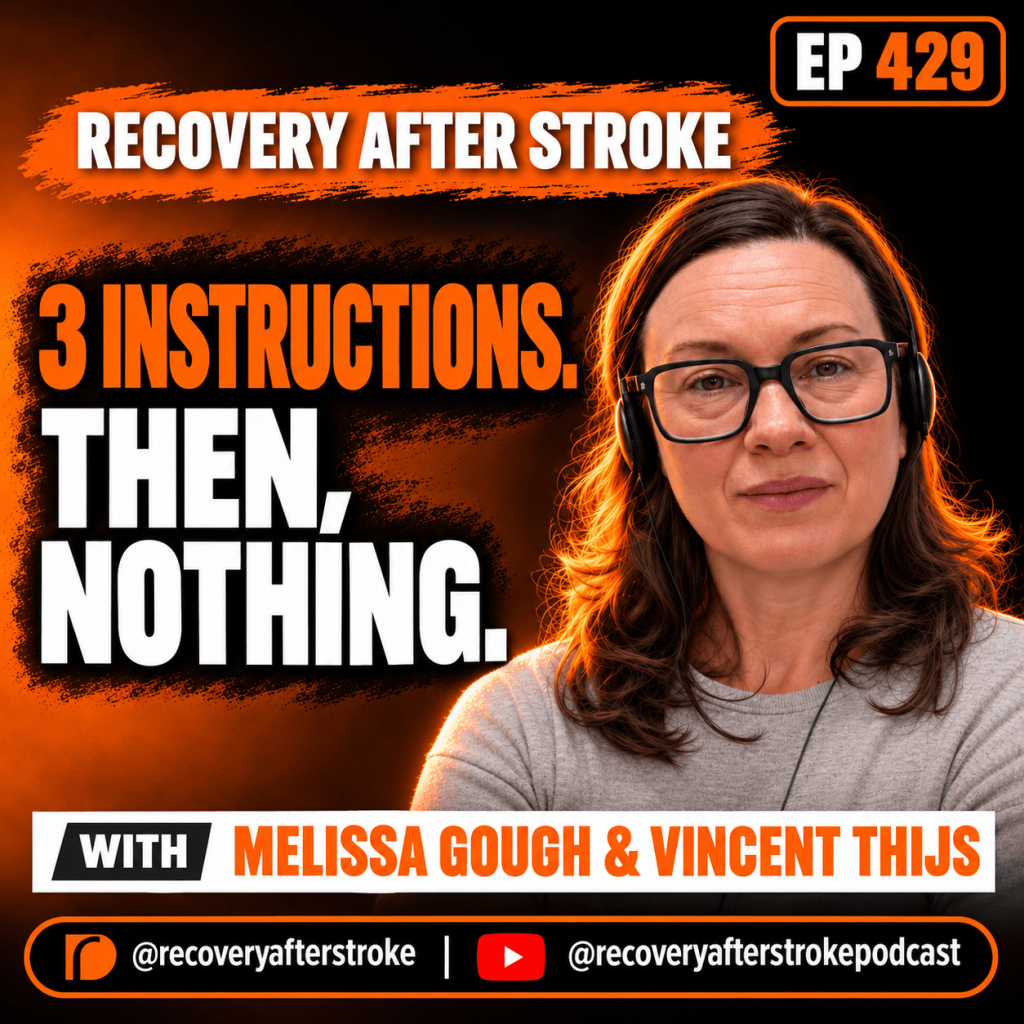
On this episode of Recovery After Stroke, I wove together two conversations. The first is with Professor Vincent Thijs, co-lead investigator of the Young Stroke Service at the Florey Institute in Melbourne, a service built for people who have a stroke between the ages of 18 and 55. The second is with Melissa Gough, the teacher above, who first helped design that service as a lived-experience contributor and then realized she needed it herself.
Before her stroke, Melissa says, the word was “often associated to someone quite elderly… or it only occurred to people who did not have a healthy lifestyle.” She didn’t fit the category. She didn’t tick the boxes. And yet.
How Common Is Stroke in Young Adults?
Vincent puts it plainly: depending on the figures you use, between 10 and 15 percent of all strokes happen in younger people. “That’s not nothing,” he says. The Florey’s own research found that 88 percent of young stroke survivors report unmet needs after their stroke, and at intake to the Young Stroke Service, people present with an average of around 30 unmet needs each.
That matches what I see on the show. Over 400 episodes, the majority of people who reach out to tell their story are under 50, and I’ve spoken with survivors in their teens and every decade since.
Three Instructions, Then Nothing
Melissa spent two weeks in hospital in May 2021, in the middle of COVID. She left with a discharge summary, a large bag of medications and three instructions: see your GP within two weeks, wait for an MRI within six weeks, and don’t drive for three months.
“Anything beyond that… was not discussed with me.”
What followed was pain once the painkillers stopped, fatigue, muddled words, a relationship that ended soon after she came home, and a return to work that never came together. She looked fragile, but because she could still speak, people assumed she was fine. That’s the invisible part of stroke that so many survivors describe, and you can hear more about it in our conversation on living with invisible stroke deficits (https://recoveryafterstroke.com/living-with-invisible-stroke-deficits/).
“It’s not like, isn’t this a nice luxury to have? It’s not a luxury, it’s a necessity.” — Melissa Gough
Why Young Stroke Needs Different Care
Here’s what reframed the episode for me. Stroke services weren’t built carelessly. They were built around the priorities of older survivors, and they do that job well.
“When you’re seventy,” Vincent says, your priorities are probably your grandchildren and your partner. Getting home and being able to walk come first. A younger survivor has those concerns plus decades still to live with the stroke, and a stroke at that age becomes something closer to a chronic condition. Along the way come new partners, children, careers and finances, all lived with the consequences of a brain injury.
That’s why the Young Stroke Service focuses on what Vincent calls the obvious gaps with good evidence behind them:
- seeing a neurologist who explains why the stroke happened and how to prevent another one
- neuropsychology and cognitive behavioral therapy adapted for brain injury
- vocational rehab, so people can return to work or study
- support to return to driving, which really means returning to mobility and independence, especially in rural areas with no public transport
Grief is part of it too. Vincent describes grief for “your former life,” and Melissa describes layers of grief, anger and shame that didn’t follow the neat stages she’d been taught. Mike Kent describes a similar road in his story of acceptance after a hemorrhagic stroke (https://recoveryafterstroke.com/acceptance-hemorrhagic-stroke-recovery/).
What a Plan Built Around You Can Find
Every person who enters the service has an intake of up to two hours with someone who knows stroke at their age, followed by a weekly multidisciplinary team meeting that builds a plan for that one person. “It’s bespoke for your individual needs,” Vincent says.
For Melissa, that plan led to something she had never been offered: a neurologist. She hadn’t seen one since leaving hospital, and private appointments would have cost thousands of dollars she didn’t have while she couldn’t work.
That neurologist told her that during the angiogram she had after her first night in hospital, she’d had more strokes, an embolic shower of smaller strokes all at once. Nobody had told her. She describes the validation of knowing something hadn’t added up, and the new mental health journey it started.
Then came a neuropsychologist, and with them something Melissa returns to again and again: grace. Grace for how she processes information, and for the steps she takes going forward. As Adam Wolfers found in his conversation about identity change after stroke (https://recoveryafterstroke.com/cerebral-vasculitis-stroke-identity-change-adam-wolfers/), recovery is rarely one profound breakthrough. More often it’s the little things.
What Happens When the Service Ends
After a five-year pilot that has supported more than 500 young Australians in Victoria and South Australia, the Young Stroke Service’s funding ends in December 2026. Vincent says the people who’ve gone through the program are now being handed over to the standard of care, “which unfortunately may be nothing.”
Melissa heard the news on social media. “My heart sank,” she says. She’s now frightened for the next young survivor who has a stroke after the service is gone.
If you live in Victoria or South Australia, you can email your member of parliament through the Young Stroke Service advocacy page (https://www.youngstrokeservice.org.au/advocacy). Put in your postcode and the email is sent for you.
You can also hear Vincent’s first conversation on the show, about the PESTO trial results (https://recoveryafterstroke.com/pesto-trial-results-vincent-thijs/), and other young survivors’ stories from Izzy Hirst (https://recoveryafterstroke.com/young-stroke-survivor-izzy-hirst/) and Erica Wasser, who had her stroke at 37 (https://recoveryafterstroke.com/young-stroke-survivor/).
The Belief to Replace
So let’s put the old belief down. Stroke is not an older person’s experience. As Melissa says, “it is an anyone’s experience.” The replacement belief is this: stroke can happen at any age, and young survivors need support built for the decades of life still ahead of them, not a shorter version of care designed for someone else.
If this conversation helped you make sense of your own stroke, my book The Unexpected Way That A Stroke Became The Best Thing That Happened (https://recoveryafterstroke.com/book) is a path to post-traumatic growth after stroke, building on the work of Richard Tedeschi and Lawrence Calhoun. And if a stroke has made your world feel smaller, my new book Your World Doesn’t Have to Stay This Small (https://mybook.to/yourworld) is a practical guide to rebuilding your life after trauma, even when you’re not ready.
If this show has helped you, you can support it at patreon.com/recoveryafterstroke (https://patreon.com/recoveryafterstroke). That support covers the cost of making the show and keeps it going.
This blog is for informational purposes only and does not constitute medical advice. Please consult your doctor before making any changes to your health or recovery plan.