
Why Your Stroke May Not Be Causing Your Brain Fatigue
For a long time after my brain surgery, I assumed my body worked like this: the stroke happened in my head, so whatever went wrong afterward would also happen in my head. Fatigue, brain fog, slow thinking all of it filed under “neurological,” all of it explained by the injury I already knew about.
That assumption turned out to be wrong, and the way I found out was almost accidental. About eighteen months after my brain surgery, I had thyroid surgery to remove a nodule so large it had pushed my windpipe and esophagus six centimeters out of place. I had no idea it was there. No lump I could see, no difficulty swallowing or breathing that I’d noticed. It was found only because I had a chest X-ray to rule out an infection, and a doctor spotted something that had nothing to do with why I’d walked in.
What followed was a slow, confusing recovery from that second surgery, and a wave of fatigue I automatically blamed on my brain, because that was the injury I already understood. It took time to realize the fatigue might be coming from somewhere else entirely: my thyroid.
Hormones and Stroke Recovery: The Connection Nobody Talks About
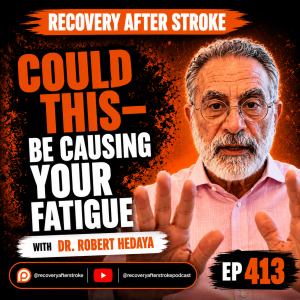
I brought this experience to Dr. Robert Hedaya, a Clinical Professor of Psychiatry at Georgetown University Medical Center and a pioneer of functional medicine psychiatry, to understand what actually happened, and to ask a bigger question: how many other stroke survivors are dealing with fatigue, brain fog, or mood changes that they’ve written off as “just the stroke,” when the real driver is a hormonal system that’s quietly stopped working properly?
Hormones and stroke recovery turn out to be far more entangled than most of us are told. As Dr. Hedaya put it plainly: the brain is a hormonal organ. Thyroid hormone, cortisol, testosterone, estrogen every one of them acts directly on brain tissue, and every one of them can be knocked off balance by the stress of a major medical event.
Why “Normal” Thyroid Bloodwork Can Still Mean Something’s Wrong
One of the most important things Dr. Hedaya explained is that a “normal” TSH result doesn’t rule out a thyroid problem, especially after a stroke. TSH is a signal sent from the pituitary gland, and if a stroke has affected the brain’s signaling pathways, the pituitary itself may not respond the way it should. A survivor can have genuinely low thyroid hormone while their TSH sits comfortably inside the standard reference range, because the system responsible for raising that number in response to a deficiency isn’t functioning correctly.
He also raised a striking data point: population studies suggest the average TSH in a healthy population is closer to 1.4, yet most labs still use an upper reference limit of 4.5, a range wide enough, statistically, to miss a real problem. His advice for survivors going into a GP appointment: ask specifically for TSH, free T4, free T3, and reverse T3, not just the standard single-marker test, and come prepared with symptoms written down if a doctor pushes back.
A Nodule That Grew in Silence
The brain is a hormonal organ. It’s an immune organ. It’s a neurological organ… there’s not one hormonal axis when it’s abnormal that cannot cause neurological or psychiatric problems.
-Dr. Robert Hedaya
My own nodule is a case study in exactly this kind of silent progression. Dr. Hedaya explained that because it grew inward rather than outward, it never created the visible lump most people associate with a thyroid problem, and because it didn’t press on my vocal cords or laryngeal nerve, I never developed the hoarseness that might have flagged it sooner. My body adapted gradually, and the fatigue that eventually surfaced was easy to misattribute to the injury I already knew I had.
Cortisol, Stress, and the Difference Between Pain and Suffering
Beyond the thyroid, Dr. Hedaya walked through the role of cortisol, the body’s primary stress hormone, and why survivors often struggle to answer a deceptively simple question: “Are you stressed?” His distinction between pain and suffering is worth sitting with: pain is often unavoidable, but suffering is shaped by the story we tell ourselves about a situation, and a stroke can compromise the very brain systems that regulate that stress response in the first place.
Testosterone, Estrogen, and the Brain’s Need for Hormones to Rewire
The conversation closed on sex hormones, testosterone and estrogen, relevant to both men and women, and their role in neuroplasticity. Dr. Hedaya drew a direct comparison to adolescence: the teenage brain rewires itself while hormone levels are surging, and the same principle applies after a stroke. A brain trying to rebuild pathways needs adequate hormonal support to do that work. Without it, recovery can stall in ways that have nothing to do with effort or physiotherapy.
What You Can Do About It
If any of this sounds familiar fatigue that doesn’t track cleanly with other recovery milestones, or symptoms a doctor has waved off as “just stress,” Dr. Hedaya’s PNIE (psycho-neuro-immuno-endocrinology) questionnaire is a useful starting point.
PNIE Questionnaire download: https://drive.google.com/file/d/1S7kC5uMFgBfS-gWcUOIHp0kOjGnrzZK5/view?usp=sharing
If thyroid function specifically is what you’re navigating, the earlier conversation with Dr. Elena Zinkov, “Stroke Fatigue and Thyroid,” goes deeper into that piece (https://recoveryafterstroke.com/stroke-fatigue-and-thyroid/). And for more from Dr. Hedaya, the first conversation on photobiomodulation and stroke recovery is a good companion listen (https://recoveryafterstroke.com/photobiomodulation-stroke-recovery/).
Getting your body back after a stroke is rarely just about the brain. My book, The Unexpected Way That A Stroke Became The Best Thing That Happened, goes further into the mindset shifts that came out of my own recovery (recoveryafterstroke.com/book). And if this podcast has helped you, you can support its continuation at patreon.com/recoveryafterstroke.
This blog is for informational purposes only and does not constitute medical advice. Please consult your doctor before making any changes to your health or recovery plan.
Hormones, Fatigue, and the Brain: Dr. Robert Hedaya Returns (Interview)
A baseball-sized thyroid nodule hid in plain sight after Bill’s stroke. Dr. Hedaya explains the hormone testing every survivor should ask for.
Support The Recovery After Stroke Podcast
Bill’s Book: The Unexpected Way That a Stroke Became Thethe Best Thing That Happened
Highlights:
01:45 Hormones and Stroke Recovery
02:11 Understanding Thyroid Function and Its Impact
17:07 Navigating Thyroid Health with Healthcare Providers
27:09 The Role of Stress and Cortisol
39:09 Nutrition’s Impact on Brain Recovery