
Curcumin and Brain Bleed Recovery: What the Research Actually Shows
If you’re recovering from a hemorrhagic stroke or a ruptured aneurysm, you’ve probably noticed that most “brain health supplement” advice online is written for the other kind of stroke: the clot type. It rarely addresses what’s actually happening inside a bleed injury: blood breaking down inside brain tissue, swelling, and a wave of secondary inflammation that can do as much damage as the bleed itself. So when someone in this community asked whether there’s any real research behind supplements for healing the brain after a bleed, it was worth digging into properly. One compound kept surfacing: curcumin, the active constituent in turmeric.
What Curcumin Is and Why It Showed Up in This Search
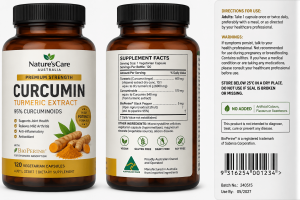
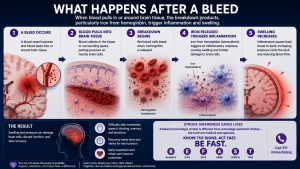
Curcumin is the primary bioactive compound in turmeric, long studied for its anti-inflammatory and antioxidant properties. It’s an unusual candidate for brain-bleed research because most stroke supplement research focuses on ischemic stroke clots where the biology is different. A bleed involves blood pooling in or around brain tissue; as red blood cells break down, iron released from hemoglobin triggers an inflammatory cascade that increases swelling and pressure inside the skull. Anything that can interrupt that cascade is scientifically interesting, at least in principle.
What the Evidence Actually Shows
The research specific to bleed-type brain injury is more developed than you might expect, but it comes with an important caveat covered below.
In animal models of intracerebral hemorrhage, curcumin reduced swelling by blocking aquaporin-4 and aquaporin-9, water-channel proteins involved in brain edema, and by calming the NF-kB inflammatory pathway that drives secondary damage after a bleed (PMID 26119880). A separate mouse study found that curcumin given within six hours of an induced brain bleed helped shrink the resulting hematoma, reduced inflammatory gene activity, and improved neurological recovery scores compared to untreated animals (PMID 21417704).
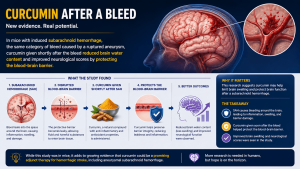
The finding most relevant to aneurysm-type bleeds specifically comes from a mouse model of subarachnoid hemorrhage, the same category of bleed caused by a ruptured aneurysm. Curcumin, administered shortly after the bleed, reduced brain water content and improved neurological scores, apparently by protecting the integrity of the blood-brain barrier (PMID 27979493).
On the human side, the picture shifts. There is currently no published human clinical trial testing curcumin specifically for hemorrhagic stroke or brain-bleed recovery. What does exist is human evidence in an adjacent area: two separate placebo-controlled trials in older adults found that a bioavailable (“lipidated”) form of curcumin improved working memory and helped prevent the cognitive decline seen in the placebo group over time (PMID 27102361; PMID 32512782). That’s genuinely encouraging evidence for brain health broadly, but it is not the same as proof that curcumin aids recovery from a bleed specifically.
A 2024 systematic review pooling curcumin and traumatic brain injury research examined eighteen studies. Every one of them was an animal study (PMID 38798711). That single fact is the most important piece of context in this entire topic.
What This Means for Stroke Survivors – The Honest Limits
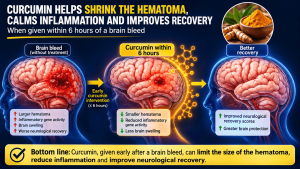
Here is the line between promising and proven: everything specific to brain-bleed recovery hematoma size, inflammation, neurological scores after hemorrhage comes from mouse studies, not human trials. Mice are not small humans, and preclinical results routinely fail to replicate in people, particularly in stroke research, where decades of promising animal data have not translated into approved acute therapies.
There is also a safety consideration that matters more here than in most supplement discussions: curcumin has a mild blood-thinning effect. If you are recovering from a bleed, on anticoagulant medication, or scheduled for any procedure, that is not a detail to skip past; it is the single most important thing to raise with your medical team before considering curcumin or turmeric extract in any form.
Practical Takeaways – Questions to Bring to Your Treating Team
Ask directly about bleeding risk before considering any curcumin or turmeric supplement, especially if you are on blood thinners or still in the early recovery window after a hemorrhage.
Ask whether the standard turmeric found in food or basic capsules is even comparable to the “bioavailable” or “lipidated” curcumin formulations used in the human trials. Standard turmeric is poorly absorbed, and the studies that showed a benefit did not use it.
Ask your doctor, or check ClinicalTrials.gov yourself, whether any human trials specific to your diagnosis are currently recruiting or have published results since this was written; the evidence base here is still moving.
The goal isn’t to decide for or against curcumin based on a YouTube video. It’s to walk into your next appointment with a specific, well-informed question instead of a vague one about “brain supplements” so your medical team can give you a real answer.
If you want to go deeper on evidence-based approaches to stroke recovery, my book covers the broader framework I used to rebuild my own recovery plan: https://recoveryafterstroke.com/book. And if this kind of research breakdown is useful to you, the Recovery After Stroke Patreon (https://patreon.com/recoveryafterstroke) directly funds more of it.
This blog is for informational purposes only and does not constitute medical advice. Please consult your doctor before making any changes to your health or recovery plan.