
Brainstem Stroke Long-Term Effects: What 11 Years of Recovery Really Looks Like
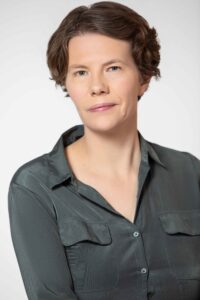
When Maggie Whittum first appeared on the Recovery After Stroke podcast in 2019 — Episode 47 — she was a few years out from a devastating brainstem stroke, still in the thick of the hardest part of recovery. She had survived paralysis, a ventilator, brain surgery, and a complete dismantling of the life she had known. At just 33 years old, a cavernous angioma — a vascular malformation affecting approximately one in 500 people — had caused a massive hemorrhagic stroke in her brainstem on Christmas Day 2014.
Now, more than eleven years on, Maggie returns to share what brainstem stroke long-term effects actually look like. Not the version you find in a clinical brochure. The real one — chronic neuropathic pain, persistent visual disturbances, deep fatigue, and the slow, non-linear process of building a new identity when the old one is no longer available to you.
Her story is also one of unexpected creativity. Maggie is now a filmmaker, artist, and disability advocate. She is the creator of The Great Now What, a documentary film exploring stroke, disability, chronic pain, and what it means to rebuild a life after everything changes. The film is in post-production and set to premiere at film festivals in 2026.
What a Brainstem Stroke Actually Does to the Body
The brainstem controls some of the most fundamental functions the body performs — breathing, swallowing, eye movement, facial sensation, and the coordination of signals between the brain and the rest of the nervous system. A stroke in this region, even a survivable one, can produce a uniquely complex set of deficits.
For Maggie, the immediate aftermath included complete left-side paralysis, inability to breathe or speak independently (requiring ventilation), and kaleidoscopic double vision with nystagmus — eyes bouncing constantly in the sockets. She underwent brain surgery and intensive rehabilitation.
Eleven years later, some of those deficits have partially resolved. Others have not. The brainstem stroke long-term effects Maggie continues to live with include:
- Hemiplegia on the left side — weak and uncoordinated movement, no sensation
- Hypertrophic olivary degeneration — constant, involuntary eye movement
- Gaze palsy to the right and nystagmus to the left
- Right-side facial palsy from cranial nerve damage
- Chronic neuropathic pain — burning, freezing, crushing, and severe pins and needles on the left side of the body
- Significant fatigue, which shapes how she works and creates
She walks with a cane. She manages these realities every day. And she has found ways to not just cope with them, but to make them the subject of her art.
When Words Are Not Enough: The Barbie Art Project
“I needed to communicate to these people better — and also my own friends and family. So I took a Barbie doll and tried to make it look like I feel.”
— Maggie Whittum
One of the most striking things Maggie has done in her recovery is find a visual language for pain that spoken language alone cannot carry. Frustrated by the difficulty of explaining neuropathic sensation to doctors, therapists, and loved ones, she created a series of modified Barbie dolls — each one representing a different aspect of how her left side feels.
Concrete Barbie has the left side encased in grey clay — the crushing heaviness. Rubber band Barbie has bands wrapped down the left side — the tightness. Vice grip Barbie has clamps all the way down — the pressure. Others are painted with fire and black — the heat and darkness of nerve pain that language cannot quite reach.
It is an act of translation. And it is also a form of advocacy — making the invisible visible for people who have never experienced it. You can find the full series on the The Great Now What Instagram page.
The Five-Year Mark — and Why It Matters
One of the most important things Maggie shares in this conversation is a framework that will resonate with many stroke survivors: the idea that it takes approximately five years to truly understand what a brainstem stroke has done to you.
This is not a clinical timeframe — it is an experiential one. The first two years, Maggie describes, were consumed by grief and the visceral shock of comparison: the life she had, and the life she now had. By five years, something begins to shift. A clearer picture emerges. A person begins to understand not just the deficits, but the new shape of their life.
For Maggie, that process was interrupted by her father’s death and the onset of COVID. But she describes herself now, at eleven years, as having genuine comprehension of what happened — and of what she has chosen to do with it.
“You’re gonna do like 10,000 things. And now that this has happened to you, you’re just gonna do a different 10,000 things — but it’s still your life.”
— Maggie Whittum
This reframe — borrowed from advice given to another wheelchair user early in his recovery — cuts through the grief of what was lost and opens a door to what is still possible. Not as consolation. As truth.
The Great Now What: A Documentary Built in Stroke Time
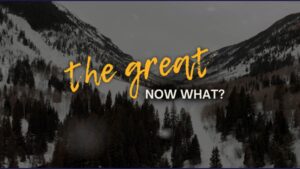
Maggie is the creator and producer of The Great Now What, a feature documentary about her stroke, her recovery, and what it means to rebuild a life with disability and chronic pain. The film has been in development for several years — slowed by COVID, by fatigue, by the realities of disabled filmmaking — and is now in post-production.
The film does not shy away from the difficult middle of recovery. Maggie is deliberate about this. She describes the typical narrative arc of recovery stories as “saccharine” — the fall, the rise, the triumphant ending, with the messy, decade-long middle compressed or erased. The Great Now What refuses to do that.
A crowdfunding campaign launches on May 1st, 2026 — Stroke Awareness Month in the United States — to fund post-production costs including editing, colour grading, sound mixing, and accessibility features (captions and audio description for visually impaired viewers). To follow the film’s journey and be notified when it becomes available, visit thegreatnowwhat.com.
Identity After Brainstem Stroke: Becoming Someone New
Before her stroke, Maggie was an actor, freelance director, and producer. She had performed at the Edinburgh Fringe, produced improv and theatre internationally, and was mid-way through a Master of Fine Arts in classical acting in Washington DC when the stroke occurred.
That version of her professional life is no longer accessible in the same way. But rather than treating this as only a loss, Maggie has constructed a new creative identity — one that includes visual art, filmmaking, disability advocacy, and public storytelling about stroke and chronic illness.
“I feel like I can call myself a filmmaker now,” she says. “I really couldn’t when I started this project.” That sentence is worth sitting with. Identity after brainstem stroke does not arrive fully formed. It is built, slowly, out of what you choose to do with the time and capacity you have.
If you are navigating that process — or supporting someone who is — Bill’s book, The Unexpected Way That a Stroke Became the Best Thing That Happened, offers a framework for understanding the deeper transformation that stroke can catalyze. And if you want to be part of a community that understands what long-term recovery actually looks like, consider supporting the Recovery After Stroke Patreon.
What This Episode Is Really About
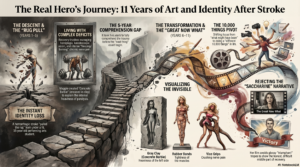
Brainstem stroke long-term effects are not just physical. They are relational, psychological, vocational, and existential. Maggie Whittum’s story, eleven years of it, makes that clear without sentimentality and without false resolution.
She is not fixed. She is not the person she was before Christmas 2014. But she is someone, a filmmaker, an artist, a survivor who has chosen to make meaning out of what happened. And that, as this conversation makes clear, is its own kind of triumph.
Listen to the full episode on the Recovery After Stroke podcast, and find Maggie’s film project at thegreatnowwhat.com.
Medical Disclaimer
This blog is for informational purposes only and does not constitute medical advice. Please consult your doctor before making any changes to your health or recovery plan.