
AVM Burst in the Brain: A Recovery Story of Patience, Aphasia, and Finding Your Way Back
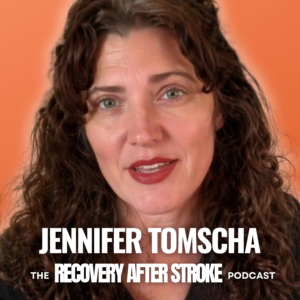
Jennifer Tomscha was 39, driving her three-and-a-half-year-old daughter home from preschool, when an AVM burst in her brain. She felt a wash of dizziness first. Then her vision started collapsing on the right side. She pulled onto a narrow verge on the highway between Greytown and Carterton in New Zealand, tried to reach her husband, got no answer, and dialled 111 instead. When the dispatcher asked what was wrong, she said something she still can’t fully explain: “I think I’m having a stroke.”
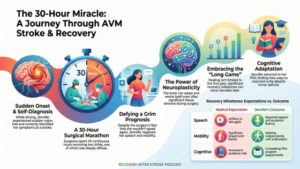
She didn’t know yet that she had two arteriovenous malformations in her left frontal lobe — one discrete, one diffuse. She didn’t know that within hours she’d be helicoptered to Wellington Hospital for an emergency craniotomy, or that the following Monday a neurosurgeon named Dr. Woon would spend thirty hours trying to remove both malformations from her brain. She just knew something was wrong, and that her daughter was in the back seat, and that she couldn’t keep driving.
That moment — pulling over, self-diagnosing, refusing the urge to simply lie down and rest — may be the reason she’s alive.
What happens when an AVM bursts in the brain
An arteriovenous malformation is a tangle of abnormal blood vessels that connects arteries directly to veins, bypassing the capillary network that normally regulates blood flow. Most people with an AVM never know they have one. But when an AVM bursts in the brain, blood floods into surrounding tissue at high pressure, and the consequences are almost always severe: haemorrhagic stroke, seizures, sudden neurological deficits, and in many cases, death.
Jennifer’s first surgery controlled the bleeding. The second, five days later, was supposed to remove both malformations. It didn’t go as planned. The surgical team discovered that blood flow to the first AVM was feeding the second one, causing the brain around it to swell. Dr. Woon had to make an impossible decision in the middle of the operation: let her die, or remove a portion of healthy brain tissue along with the malformation.
He chose to keep her alive. The surgery took thirty hours. When it was finally over, he called her husband and said, “Well, you’ll be lucky if she talks.”
The six weeks she can’t remember
Jennifer has no memories of the first six weeks after her AVM burst. She was in a medically induced coma for the surgery, then in intensive care, then transferred to rehabilitation. Everything she knows about that period has been told to her by other people.
When her memory started returning, she found herself in a rehabilitation ward in Masterton, using adult nappies, unable to sit up in bed. The front of her skull had been removed and wouldn’t be replaced for months. She wore a protective helmet whenever she walked. And yet — she insists — she felt fine.
[Quote block — mid-article]
“I kept saying, ‘I’m okay, I’m fine. You guys should just take it easy around me.’ But of course, I wasn’t really fine.” — Jennifer Tomscha
The honest recognition of what had happened to her didn’t come for almost two years. It took that long for her brain to have enough capacity to think about her brain.
The myth of the one-year recovery window
Most stroke survivors are told, either directly or by implication, that the first year matters most. That after twelve months, improvements slow. That after two years, you’ve plateaued.
Jennifer’s experience — and the experience of nearly every long-term survivor interviewed on this podcast — contradicts that narrative. Four years after her AVM burst, she is still discovering what recovery means. Her academic writing, once her profession as the Director of the Writing Program at NYU Shanghai, doesn’t flow the way it used to. She can’t recall songs from memory anymore, or sing the ones she used to sing. Her aphasia shows up most at night, when she’s tired. She still takes an afternoon nap most days.
But she’s also finishing a PhD. She can read as well as she ever could. She’s speaking, articulately, in a podcast interview eighty minutes long. And the parts of recovery she thought had stopped improving are, quietly, still improving.
What Jennifer wants other survivors to know
Her advice, offered near the end of the conversation, is short and unsparing:
“You can rest, and that’s okay. You can be as slow as you want to be, and that’s also okay. But don’t give up. Just keep going — at whatever pace feels right.”
It’s a rejection of both the productivity culture that tells survivors to push harder and the clinical culture that tells them to accept their limits. Recovery, for Jennifer, isn’t a race against a deadline. It’s a long, patient process of finding out what comes back and learning to live fully with whatever doesn’t.
Bill’s book and community
If Jennifer’s story resonates with you, Bill Gasiamis’s book — The Unexpected Way That A Stroke Became The Best Thing That Happened To — explores the same territory: the slow, unexpected, sometimes beautiful work of rebuilding a life after a brain event.
Readers who want to support the podcast and connect with the community of survivors it serves can do so at Patreon.
This blog is for informational purposes only and does not constitute medical advice. Please consult your doctor before making any changes to your health or recovery plan.
Jennifer Tomscha: An AVM Burst in Her Brain at 39, and the Four-Year Climb Back to Herself
She self-diagnosed her own stroke while driving with her daughter. Four years on, she’s still discovering what recovery really means.
Highlights:
00:00 Introduction and Background
10:00 Reflections on the Experience
18:00 Long-term Effects and Adaptations
26:45 Identity and Self-Perception Post-Stroke
38:48 The Long Game of Recovery
51:07 The Journey of Recovery
01:03:42 The Evolution of the Podcast