
EWOT for Stroke Recovery: The Affordable Alternative to Hyperbaric Oxygen Therapy
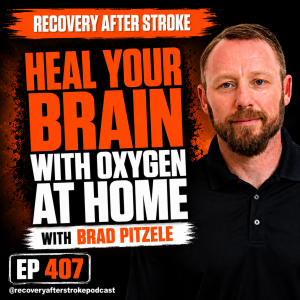
Brad Pitzele did not set out to become an oxygen therapy equipment maker. He set out to survive. After years of battling significant health challenges, conventional medicine had given him answers that kept failing him. He tried around 200 treatments. Some helped. Many did not. Then he found EWOT Exercise With Oxygen Therapy, and something finally shifted.
Brad’s journey is not the same as a stroke. But what he discovered about oxygen, inflammation, and cellular energy maps directly onto one of the most stubborn obstacles stroke survivors face: the feeling that the brain has gone offline, that the body is running on empty, and that the path back is either impossibly expensive or simply does not exist.
In Episode 407 of the Recovery After Stroke podcast, Brad shares what EWOT is, why it works, and why he now makes affordable EWOT systems through his company, One Thousand Roads, specifically so survivors do not have to remortgage their homes to access oxygen-driven recovery.
What Is EWOT?
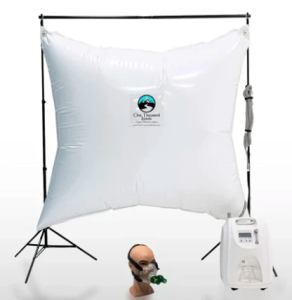
EWOT stands for Exercise With Oxygen Therapy. The concept is straightforward: you breathe high-concentration oxygen through a mask while exercising even lightly, and that combination pushes oxygen into parts of the body that normal breathing cannot reliably reach.
Most people assume oxygen therapy means a hyperbaric chamber: a pressurized tube, a clinic, a course of treatments costing tens of thousands of dollars. Hyperbaric oxygen therapy (HBOT) is effective. Brad describes it as “a heroic treatment.” But it is also inaccessible for most survivors, financially and logistically.
EWOT operates on a related principle without the chamber. The key mechanism is not about oxygenating red blood cells; they are already carrying close to their maximum load under normal breathing. The target is the blood plasma. Plasma does not carry oxygen efficiently under resting conditions, but during exercise, even light exercise, blood pressure and circulation increase enough to force dissolved oxygen into the plasma. That plasma can then reach the micro-capillaries, the tiny vessels that feed tissues deep in the body, including areas of the brain that become inflamed and oxygen-starved after a stroke.
The Post-Stroke Energy Problem
One of the most commonly reported and least-explained symptoms after stroke is fatigue that does not go away, no matter how much a survivor rests. Most survivors are told that is just part of it. Brad’s framework centres on mitochondrial dysfunction.
Mitochondria are the energy-producing structures inside cells. After stroke, the cells in and around the affected area are often not dead; they are in a kind of low-power state. Brad describes it as a “brownout”: the lights are on, but dimly. The mitochondria are not producing energy at full capacity, and one significant reason for that is insufficient oxygen supply to the tissue.
“The cells that are offline after a stroke are not all dead. Some of them are just starving. Oxygen is part of what feeds them back.” — Brad Pitzele, Episode 407
When EWOT increases plasma oxygen during exercise, it can reach those inflamed, under-oxygenated micro-capillaries that larger vessels cannot access. The result, for some survivors, is a gradual improvement in energy, cognition, and physical capacity, not because the therapy is miraculous, but because it addresses a specific physiological deficit that conventional post-stroke care often does not target.
EWOT vs. Hyperbaric: What’s the Real Difference?
The honest answer is that EWOT and hyperbaric oxygen therapy are not equivalent. HBOT delivers oxygen under pressure, which drives it into tissue more forcefully. For certain conditions, particularly in acute or severe cases, hyperbaric oxygen has a stronger evidence base.
But for many stroke survivors in the subacute or chronic phase of recovery, access is the defining variable, not theoretical ceiling. A home-based hyperbaric unit costs $50,000 to $75,000. A clinical course can run to $60,000 or more. EWOT systems are available for under $2,000.
The question Brad puts to survivors is not “which is better in a lab?” It is: “Which one can you actually do, consistently, at home, over the months and years that brain recovery requires?” Consistency matters more than peak intensity in long-term neurological recovery.
Starting EWOT With Deficits
EWOT does not require running on a treadmill. The exercise component can be a stationary bike, a recumbent bike, or simple seated leg movements with one limb strapped in. The goal is to raise circulation enough to push oxygen into the plasma, not to hit a cardiovascular fitness target.
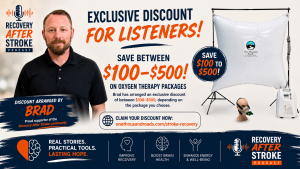
For survivors exploring this option, Brad’s team has built a specific resource at onethousandroads.com/stroke-recovery with a listener discount of $100 to $500, depending on the package. There is also a broader introduction to EWOT at onethousandroads.com/pages/exercise-with-oxygen-therapy.
Recovery Is Possible – And It Does Not Have to Be Expensive

If this episode resonated with you or if you want to explore more conversations about recovery options that do not require a second mortgage, Bill’s book, The Unexpected Way That A Stroke Became The Best Thing That Happened, is available at recoveryafterstroke.com/book.
And if the Recovery After Stroke podcast has been useful to you, you can support it financially at patreon.com/recoveryafterstroke. Every contribution helps keep the show going and these conversations accessible to survivors around the world.
This blog is for informational purposes only and does not constitute medical advice. Please consult your doctor before making any changes to your health or recovery plan.
EWOT for Stroke Recovery: The Affordable Alternative to Hyperbaric Oxygen Therapy
Why pay $60,000 for hyperbaric oxygen? EWOT brings oxygen therapy into your living room — and could help the brain cells that are only offline.
One Thousand Roads
Exercise With Oxygen Therapy (EWOT)
YouTube Channel
Dive deeper on EWOT and red light therapy.
Read the blog on Oxygen therapy for Stroke Recovery
Highlights:
00:00 Introduction and Background
05:37 Challenges in Stroke Recovery and Treatment Options
13:45 Understanding Oxygen Therapy and Its Mechanism
15:51 Oxygen Toxicity Explained
19:24 The Importance of Oxygenating Blood Plasma
24:53 Oxygen and Mitochondrial Function
31:16 Adapting Exercise for Stroke Survivors
38:27 Cost and Accessibility of Oxygen Therapy Devices