
Crying After Stroke: What Bobby Chaggar’s Recovery Taught Him About Grief and Strength
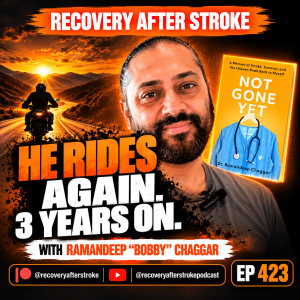
The night his stroke happened, Ramandeep “Bobby” Chaggar didn’t feel what he expected to feel. No pins and needles. No dramatic collapse. Just a left arm that wouldn’t answer him anymore.
He limped to the kitchen anyway, poured a glass of water, and brought one back for his wife because that’s what you do, even when your body has just stopped taking instructions from half of itself. It wasn’t until the ambulance service ran him through the BFAST test over the phone that the word “stroke” entered the room. A right ischaemic pontine stroke, in December 2023. He was, by his own account, in the best health of his life at the time: no blood pressure issues, no diabetes, cycling a hundred kilometres most weekends.
Growing Up Believing a Stroke Meant You Were Gone
Bobby grew up in an era and a family where a stroke wasn’t something you researched; it was something you heard about secondhand. “That particular cousin’s father’s grandfather had a stroke, and he’s gone,” is how the news used to travel. Nobody around him distinguished a stroke in the brain from a stroke in the heart. There was no internet to check, only the flat, final verdict that passed between relatives: he’s done for.
It’s a belief he carried into his own stroke, even as his medical training Bobby spent years as a veterinary surgeon in India before qualifying in Australia told him something else was happening. That veterinary background is exactly why he recognised what was going on in his own body faster than most people would. It didn’t make the belief disappear. It just meant he was fighting it from the inside while everyone around him was still catching up.
Why His Arm Seemed to Move Then Stopped
In those first disorienting hours, Bobby was convinced his arm had started moving again. He filmed it and sent the video to his sister as proof, he thought, that he was already turning a corner. By morning, the movement was gone. “It was like a bad dream,” he says. “I was like, what was that?”
What he was seeing wasn’t recovery. Doctors later explained that in the earliest hours after a stroke, the body can still fire off remnant spinal reflexes old movement patterns held in the spinal cord that can briefly activate on their own, independent of the brain damage that’s actually occurred. It’s a strange, almost cruel mechanism: the body offering a flicker of hope before the real work of recovery has even started.
The Physio Who Promised Him He’d Walk Again
Bobby spent 45 days in rehabilitation at Parkville, six months in a wheelchair overall, and credits one moment above almost everything else: his first physiotherapist he calls her Hannah sitting on the floor, moving his foot, and telling him he would walk again. It mattered enough that his book was originally going to be titled Walking with Hannah, before privacy considerations changed the plan. His son, who narrates the audiobook, still opens the acknowledgements by thanking her directly.
Learning to Cry Again
This is the part of Bobby’s story that speaks most directly to what so many stroke survivors go through and rarely say out loud. In his culture, and in his family, showing emotion, especially for the men expected to be providers and caretakers, wasn’t really an option. When his father died in 1997, he was told to be strong for his mother and sister. When his mother died in 2013, he was told the same thing again.
“I’ve been told that stroke is a part of grief, and you should not suppress your feelings.”
It took his brother-in-law showing up every day to help him with basic care showering, dressing, the things that felt hardest to accept before something shifted. His own psychologist eventually gave him the instruction that reframed everything: put on your own life jacket first, before you try to save anyone else. It’s advice Bobby now extends to every caregiver he talks to: the person supporting a stroke survivor needs their own support too, or they burn out trying to hold everything together.
He isn’t alone in this. Bill has spoken openly on the podcast about his own experience with unexpected, involuntary crying after a neurological injury, and how much energy goes into reassuring the people around you that the tears don’t mean something is wrong. For Bobby, permission to cry didn’t erase the culture he was raised in. It just meant he stopped fighting it.
A New Normal, On His Own Terms
Bobby’s recovery is full of small, deliberate acts of reclaiming identity. He got his first tattoo not long after his stroke, partly, he says, because people notice ink before they notice a limp. He’s spent years slowly making peace with not tying a turban the way he used to, calling himself, with real affection, a recovering “turbanator.” He built his own incline-and-decline walking circuit near his home and quietly upped the difficulty every fortnight, the same instinct that now has him choosing stairs over the lift at the allied health course he’s completing.
Running, he says flatly, is overrated. He can’t do it anymore, and he’s decided that’s fine. It’s the same acceptance that let him and his family move to Perth just one month after his stroke, and then move back again when isolation made the recovery harder than the geography ever was.
None of it looks like the version of recovery he grew up believing in, the one where a stroke simply meant a story was over. Bobby’s version has a motorbike with a sidecar he now rides himself, a book he wrote one voice note at a time because typing with one hand wasn’t fast enough, and a fairly simple message for anyone who asked him to just think positively: some things are still hard, and that’s allowed to be true at the same time as everything else.
If you’re navigating your own recovery or supporting someone who is, Bill’s book, The Unexpected Way That A Stroke Became The Best Thing That Happened (recoveryafterstroke.com/book), walks through ten practical tools for rebuilding after a stroke. And if trauma has made your world feel smaller than it used to be, Bill’s newest book, Your World Doesn’t Have to Stay This Small, is written for exactly that.
If this episode helped you, you can support the show directly at patreon.com/recoveryafterstroke.
This blog is for informational purposes only and does not constitute medical advice. Please consult your doctor before making any changes to your health or recovery plan.