
Single Parent Stroke Recovery: How Jeff Manuel Is Rebuilding His Life for His Kids
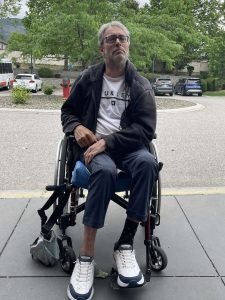
Jeff Manuel was working two jobs to provide for his two teenage kids – a full-time role in electrical sales plus evening grocery-delivery shifts – when a stroke at 52 changed everything about how he could show up for them.
Four years later, he’s not back to where he was. He’s become someone different, and by his own account, someone he likes better.
A Normal Saturday Morning, Then Everything Changed
Jeff’s stroke happened on a Saturday in March 2022, but the warning signs started the night before, on his last work shift.
The next morning he made coffee, showered, and drove to drop off his kids’ things at their mother’s house in West Kelowna. When she opened the door, she immediately knew something was wrong – his face had visibly dropped.
A local clinic ran a squeeze test that came back fine and prescribed inhalers for what they assumed was a breathing issue. It wasn’t until Jeff tried to pick up oranges with his left hand an hour later, and couldn’t, that they went to the hospital. A CT scan confirmed he’d had a stroke. He couldn’t move his arm or his leg.
Raising Two Teenagers From a Hospital Bed
Single parent stroke recovery comes with a particular kind of weight: the practical question of who looks after your kids while you can’t. Jeff and his ex-wife were separated but living close by, and when he was hospitalized for three months, she and their children – a boy and a girl, both thirteen at the time – stepped in to support him.
She’s been doing a lot for me, and I really appreciate it.
What could have been an awkward or strained dynamic instead became a stronger friendship than the one they’d had before the stroke. Jeff is candid about why the timing mattered to him:
Thank goodness it happened when I was only fifty-two and not seventy-eight, when they’d got their families all grown up and their own worries. I didn’t want to be a worry to their father.
His kids are now nearing graduation, and he stays in touch by text and phone, even though he doesn’t get to see them as often as he’d like.
Two Years Learning to Live Again
After hospital, Jeff moved into a residential rehabilitation program called Connect Communities, where he spent two years relearning basic independence – from walking to cooking to managing a wheelchair-accessible home.
Progress wasn’t linear: partway through, his wheelchair tire caught on a mat and led to a fall that required a hip replacement, adding more recovery time on top of the stroke rehab.
The program used occupational therapy milestones to unlock privileges – once he could complete a task within a set time, he earned the ability to grocery shop and cook for himself, working up to preparing a meal every night.
That system became his bridge from full-time care toward the assisted living arrangement he’s in now, which he describes less as being stuck and more as “graduating” toward independent living.
Managing Pain That Doesn’t Go Away
Chronic pain has been one of the harder, more persistent parts of Jeff’s recovery – constant pain and tension on his left side, in his shoulder in particular.
After four years of prescribed medication, Jeff made his own decision to stop his pharmaceutical pain pills and manage his pain with medicinal marijuana gummies instead, taken a few times a day.
He credits them with helping not just with pain, but with sleep and digestion too. This is Jeff’s personal experience and decision, made under his own judgment about his body after years of living with it post-stroke – not a treatment recommendation, and as always, any change to medication should be made in consultation with your own medical team.
A Rebirth, Not Just a Recovery
What comes through most clearly in Jeff’s story isn’t the physical rehabilitation – it’s the internal shift alongside it.
He describes the last ten years before his stroke as a period of grief he hadn’t fully processed, following the deaths of his mother and sister, and a tendency to put himself first that he says didn’t serve his family. The stroke, paradoxically, became the catalyst for the opposite:
I’d like myself again because I know I’m a good person.
He talks about his recovery in openly spiritual terms – leaning on his mother’s belief that “everything happens for a reason,” and describing his body’s limitations as temporary: “This is only part of your meat suit.” He’s quick to add that this reframing isn’t about denying the hard days. It’s about noticing small, cumulative wins:
Sometimes you’re not aware of what’s happening, and then you think about it – I couldn’t do that yesterday, now I can.
What Keeps Him Going
Jeff found Recovery After Stroke the same way many listeners do – searching for answers in a hospital bed, trying to understand what had just happened to him.
I’ve seen so many other people going through it. It really did help me.
Now, four years on, he’s paying that forward by sharing his own story, pain and all, with the same honesty he found helpful when he needed it most.
If Jeff’s story resonates with your own recovery – or your own path back to being fully present for the people who depend on you – Bill’s book, The Unexpected Way That A Stroke Became The Best Thing That Happened, digs deeper into this kind of transformation: recoveryafterstroke.com/book.
If this show has helped you, you can support it directly at patreon.com/recoveryafterstroke.
This blog is for informational purposes only and does not constitute medical advice. Please consult your doctor before making any changes to your health or recovery plan.
Jeff Manuel: Raising My Kids Through a Stroke and Learning to Like Myself Again (Interview)
A single dad’s 4-year journey from hospital to independence – raising his kids, relearning to cook, and rebuilding who he is.
Highlights:
00:00 Jeff’s Journey: Single Parent Stroke Recovery
04:01 The Day of the Stroke
06:42 Personal Transformation Post-Stroke
09:03 Rewiring the Brain and Recovery
11:04 Support During Recovery
13:32 Mindset and Spiritual Growth
15:25 Challenges of Recovery
18:52 Personal Transformation and Reflection
20:24 Daily Life in Assisted Living
24:01 Pain Management and Coping Strategies
26:28 Future Aspirations and Independence
28:13 Finding Community and Sharing Stories
Transcript:
Jeff’s Journey: Single Parent Stroke Recovery
Jeff Manuel (00:00)
Once you get over what has happened, you become a better person.
I like myself again because I know I’m a good person.
if it takes another four or five years to walk again, it takes that.
But if I can get as many tools into my tool chest, I can use later in life.
Bill Gasiamis (00:18)
Welcome back Recovery After Stroke. I’m Bill Gassiamis. My guest today is Jeff Manuel, a single father of two teenagers who was working two jobs full time in electrical sales plus evening grocery delivery when he had a stroke at 52 that left him with left-side paralysis. Jeff describes his stroke as involving a clot and possibly a bleed as well. The exact clinical picture is something we talked through together in the episode.
We get into what it’s like raising teenagers through three months in hospital and two years in residential rehab, and how his relationship with his ex-wife has changed since the stroke, how he’s learned to cook again with one hand and the pain management approach he’s landed for himself after four years of recovery. Quick note before we dive in, if you’re feeling stuck in your own recovery, I now offer one-on-one coaching for stroke survivors.
It’s not therapy or medical treatment, it’s lived experience support, structure, accountability, and someone who’s actually been where you are, having survived three strokes myself. I only work with a small number of people at a time, so it stays meaningful. You can apply at recoveryafterstroke.com/momentum. If Jeff’s story resonated with you, I also wrote a book about my own experience called The Unexpected Way.
That a stroke became the best thing that happened, it is available at recoveryafterstroke.com/book. And if this show has helped you, you can support it directly at patreon.com/recoveryafterstroke. Here’s my conversation with Jeff.
BIll Gasiamis (01:58)
Jeff Manuel. Welcome to the podcast.
Jeff Manuel (02:01)
Thanks for having me.
BIll Gasiamis (02:01)
Tell me a little bit about what life was like before stroke. What were your daily tasks? What kind of things did you get up to?
Jeff Manuel (02:10)
at the time I had two jobs. I had full time journal day and then after after the day job I would go and
And I was I was before I was in a loop to try to catch up and
Provide for my family.
BIll Gasiamis (02:22)
What kind of jobs did you do?
Jeff Manuel (02:23)
I was my last job was in sales, electrical sales.
And I used to I would pick groceries for customers that were just driving by and picking up the groceries. So I’d pick mostly the the dry goods and have it ready for when they eat when they were ready to pick up the groceries.
BIll Gasiamis (02:41)
Was that the after hours job?
Jeff Manuel (02:42)
Pardon me?
BIll Gasiamis (02:42)
Was that the after hours task?
Jeff Manuel (02:45)
Yes.
BIll Gasiamis (02:45)
And how many hours a a week would a day would you say you were working then?
Jeff Manuel (02:48)
I’d be I’d probably have four four four shifts a week.
Sometimes less.
BIll Gasiamis (02:53)
And on the day of one of your shifts.
Jeff Manuel (02:54)
It was manageable
at the time.
BIll Gasiamis (02:56)
It was manageable.
Jeff Manuel (02:57)
Yes.
BIll Gasiamis (02:57)
And on the day of one of the shifts that you went to your regular job and then you did one of those shifts, how many hours would you say that?
Jeff Manuel (03:06)
Five hours.
I believe I worked the five hours that was on my stroke happened on a Saturday. This was a Friday night. So I believe it was five hours. Cause I was started it at five and I finished at ten.
BIll Gasiamis (03:07)
The added
So with your full time job, the regular job, that would be a normal eight hour day and then you would do an additional five hours?
Jeff Manuel (03:30)
Yes.
BIll Gasiamis (03:30)
Okay. And w other than work, what else did you get up to?
Jeff Manuel (03:37)
I’m a single father of two kids.
So as much time as I could spend with him I spent with them even though we were not living in the same house.
BIll Gasiamis (03:45)
Understood. How old were the kids?
Jeff Manuel (03:46)
Thirteen.
BIll Gasiamis (03:47)
Two boys, two girls.
Jeff Manuel (03:49)
boy to give us
BIll Gasiamis (03:50)
Sorry, Jeff, what was that?
Jeff Manuel (03:51)
Boy and
a girl, I’m sorry.
BIll Gasiamis (03:52)
A a boy and a girl.
And you were working the extra hours to cover everybody and make sure they had everything they needed.
Jeff Manuel (04:00)
Yes.
The Day of the Stroke
BIll Gasiamis (04:01)
And what what happened on the day of the stroke, Jeff?
Jeff Manuel (04:05)
Well, I woke up Saturday morning, everything was fine.
Put on the coffee machine. Went and got a quick shower.
Packed up my clothes cause I was going to to their house ’cause they lived with their mother in West Kelowna. And I was living in Peachland at the time. So I drove on the highway, popped into McDonald’s, cup of coffee, couple of sandwiches, and then they were just two minute drive away. knock on a door.
She opens the door and she says, What the heck happened to you? I said, What do you mean?
She said your face is on the ground. My whole left side, I guess, just collapsed.
So then she says we’re going to the clinic.
Is it okay? So go over does a squeeze test. I mean both hands, fine.
And I was walking and talking and doing everything. Like nothing happened yet.
I said the only the only issue I had was a little bit of breathing problems a couple of months previous.
So we prescribe some inhalers and see if that helps.
Mm got the inhalers, tried out an hour later. Didn’t do anything for me.
Then I tried picking I had a shift at twelve o’clock and this was probably about eleven. And I went into the kitchen and tried picking up oranges with my left hand and I couldn’t grab it and put it in the bag and she said, We’re going to the hospital. So, okay. Then I was getting worried. So I didn’t know what it was.
BIll Gasiamis (05:29)
And and then you spent some time in hospital doing tests, were you?
Jeff Manuel (05:32)
Heard me?
BIll Gasiamis (05:32)
Then you spent some time at hospital, were they testing you?
Jeff Manuel (05:34)
Interested C D scan.
Then he comes down and tells me that Mr. Manuel you had a stroke.
Said okay. And then I still can’t comprehend what that actually meant. But I knew it was something wrong. And it wasn’t till the next day that I couldn’t move my arm or my leg.
BIll Gasiamis (05:52)
Mm-hmm. And how long ago was that, Jeff?
Jeff Manuel (05:56)
That was in
Right of twenty twenty two.
BIll Gasiamis (05:59)
March of twenty twenty two.
Jeff Manuel (06:01)
Yes.
BIll Gasiamis (06:01)
Got it. And you seem to be quite still significantly emotionally upset about it. Do you find that you’re have a a few challenges about dealing with your emotions?
Jeff Manuel (06:11)
that’s cool.
I’m sorry, Bible is not upset. It’s happiness.
BIll Gasiamis (06:18)
It’s happiness.
Jeff Manuel (06:19)
I’ve turned a big corner this year And I’m happy I’m happy where I am I’m happy for who I am
This is just temporary. I know that. And I’ve learned to live with it for four years and it’s okay. I’m good.
BIll Gasiamis (06:34)
Lovely, man. So who are you now? Who are you now that you’re happy with who has turned the corner?
Personal Transformation Post-Stroke
Jeff Manuel (06:42)
I’m I’m more of myself a long time ago with the name. In the last ten years it’s
It’s just listening to other people having a broadcast and internalizing it and using it for the good.
And trying to help people as much as I can. Even it just means a smile and hey you’re doing a great job. That means the world to people.
And for some people they can’t say it, so I’d say it for them.
BIll Gasiamis (07:02)
Mm.
So the the the guy from ten years ago wasn’t happy. What was wrong with that guy? Like what is it that he wasn’t doing that wasn’t serving you?
Jeff Manuel (07:15)
I wasn’t paying attention to what I had to pay attention to my my wife and kids.
I was up north and in the North Territories, which is Canada’s Arctic, for twelve years. Awesome years. Beautiful people.
BIll Gasiamis (07:32)
And what were you doing there? What was the task?
Jeff Manuel (07:35)
Doing a couple of different jobs. My last job was I was assistant manager of like a Costco.
But it was a a locally owned Inn Valley store, so
BIll Gasiamis (07:42)
I went
Jeff Manuel (07:46)
When my boss would be out of town I would have to look after the stores and transfer to other parts of the Arctic.
BIll Gasiamis (07:46)
And were you away from your family at that time?
Did that have you away from your family?
Jeff Manuel (07:55)
No, my family lived right in the same community, so
BIll Gasiamis (07:57)
Uh-huh. And what you you weren’t satisfied with the way you were going about life? What was the difference between now and then? Because you’re quite co comfortable suggesting that there’s been a shift, a change? Were how how were you not
Jeff Manuel (08:13)
I was
drinking way too much.
And then along with grief.
BIll Gasiamis (08:18)
What was the grief in relation to?
Jeff Manuel (08:19)
my mother and my sister had passed away from cancer. But like pretty close to tw twenty years ago now. So and recently it’s been my brother. So it’s been I’ve been thinking a lot about that.
BIll Gasiamis (08:32)
And were you using alcohol to cope before the stroke?
Jeff Manuel (08:34)
Yes.
BIll Gasiamis (08:35)
And did that mess up your relationships?
Jeff Manuel (08:36)
Not necessarily.
BIll Gasiamis (08:37)
How how was it that you weren’t doing the right thing by your family?
Jeff Manuel (08:41)
I’m just thinking more about myself than others.
BIll Gasiamis (08:44)
Putting yourself first.
Jeff Manuel (08:46)
Yes.
BIll Gasiamis (08:46)
Mm-hmm. Got it. And then the stroke happened and how did that change everything? Because the stroke made you unwell. It put you in hospital. But how did that shift the way that you behaved and the the way you went about life?
Rewiring the Brain and Recovery
Jeff Manuel (09:03)
Well, in this is my fourth year, so this year I know that my brain is rewiring itself because I can see minuscule changes every single day.
And sometimes you’re not aware of what what what’s happening and well then you think about it and I couldn’t do that yesterday, now I can do it.
BIll Gasiamis (09:24)
understood. And hello
Jeff Manuel (09:26)
And it’s a it’s a
it’s it’s a positive positive thing that happens to you every single day.
BIll Gasiamis (09:32)
Got it, I appreciate that. So you’re seeing small significant changes that are adding up and you’re getting results from that. And it’s been for years now.
Jeff Manuel (09:40)
Yes. I’m happy to say
BIll Gasiamis (09:41)
Understood. That’s excellent. Now, what kind of stroke was it? Did they determine the cause and have they put you on some kind of medication or program to prevent another one? What was the issue with the stroke?
Jeff Manuel (09:54)
No, it was a hemorrhagic stroke on the the right side.
Yeah, I was prescribed a whole bunch of pills and stuff.
I guess it helped at the beginning. I couldn’t tell.
BIll Gasiamis (10:03)
Did they tell you what caused the brain hemorrhage? Do you know?
Jeff Manuel (10:06)
the the doctor said said there was a clot in my this part of the artery on the my right side and my neck. And he also told me that I had a heart attack the week before.
But I didn’t see it, I think. It was just a mark one, I guess.
BIll Gasiamis (10:21)
So so was
So was it a brain hemorrhage or an ischemic stroke?
Jeff Manuel (10:27)
Maybe it’s a brain hemorrhage.
BIll Gasiamis (10:28)
Bleed in the brain?
Jeff Manuel (10:29)
Yes.
BIll Gasiamis (10:30)
Okay. But the clot usually refers to an ischemic stroke, which is like a very different from a a bleed on the brain.
Jeff Manuel (10:39)
No, the it was just the vein that was clouded.
BIll Gasiamis (10:41)
Uh-huh.
As well as a brain hemorrhage.
Jeff Manuel (10:43)
Yes.
BIll Gasiamis (10:43)
So you were really going through it. You had a heart attack, a clot issue and a brain hemorrhage all at the same time?
Jeff Manuel (10:49)
Yes.
BIll Gasiamis (10:49)
Wow. Under. Got it. So how long did you spend in hospital, Jeff?
Jeff Manuel (10:55)
I was there from march twelfth to June fourth ninth in the hospital.
BIll Gasiamis (11:02)
About three months.
Support During Recovery
Jeff Manuel (11:04)
Yes.
BIll Gasiamis (11:04)
And who was there to support you during that time? Because if you’re if you’re no longer married and you live separately from your your former wife, who was by your side? How how did you get through that time?
Jeff Manuel (11:18)
That’s funny because it was my ex wife and my children.
She would bring in to see me and f they would feed me and look after me.
BIll Gasiamis (11:28)
That’s very cool. She stepped up.
Jeff Manuel (11:31)
She did she’ve been doing a lot for me. And I really appreciate it.
BIll Gasiamis (11:35)
Yeah, that is lovely. And then you left from the hospital. At some point they dismissed you or discharged you. Did you have to go into rehab after that to try and get your your left side up back up on board?
Jeff Manuel (11:51)
Well, in the hospital I was doing really hard but but I couldn’t I could still couldn’t walk or go up steps or anything, but they applied to put me into Connect. It’s called Connect Communities. And there was a whole bunch of different houses you live in. And it’s like you have your own room, you have your shower days, and you get fed three meals a day.
But everything was wheelchair accessible.
And it was the best two years I had.
There was that place was amazing. The people were amazing. And what they offered ya and taught you was amazing.
BIll Gasiamis (12:26)
Yeah. It sounds like you’ve gone on qu quite a spiritual kind of shift, some kind of a journey, an internal journey as well as the physical healing of your body.
Jeff Manuel (12:35)
Exactly.
This I can live with. This is only part of your meat suit you’re aiming your leg. It all depends on what’s upstairs and how you can teach p other people to live with what’s happening.
BIll Gasiamis (12:49)
What’s one of the biggest things that you learnt when you were in there, by the time you left after two years? Because at the beginning I imagine you wouldn’t have been as upbeat, as positive as you are now.
Mindset and Spiritual Growth
Jeff Manuel (13:02)
No, because
You still are learning your your
limits of being disabled or paralyzed. You still gotta live it’s like a regrowth. You learn from a baby again to crawl and then walk. And it’s like up until then it’s learning you think about things if you have to use the watchroom you think about it like twenty five different times before you actually use it.
It’s a like a learning process. And I’m just starting to learn again.
BIll Gasiamis (13:37)
So it sounds like the biggest recovery that you had that’s been the most meaningful then was that kind of mindset part of your recovery, the spiritual part of your recovery.
Jeff Manuel (13:47)
I I
I think once you get over what has happened, you become a better person.
But I I’d like myself again because I know I’m a good person.
And if it takes another four or five years to walk again, it takes that.
But if I can get as many tools into my tool chest, I can use later in life.
BIll Gasiamis (14:09)
Yeah. Yeah. And you know what I love about that is you’re kind of setting an example for your kids, right? Y they may not know it and
Jeff Manuel (14:16)
I tried to my best to set an example because I always said, Thank goodness it happened when I was only fifty two and not seventy eight when they got their families all grown up and their own worries. Didn’t want to be wrong about their father.
They stepped up and being adults when they were thirteen.
BIll Gasiamis (14:34)
Yeah. Were you also a smoker then?
Jeff Manuel (14:35)
Yes.
BIll Gasiamis (14:36)
Okay.
Jeff Manuel (14:36)
I did quit three months before going into hospital but I’m back smoking again, so
BIll Gasiamis (14:41)
You’re back smoking again at the moment?
Jeff Manuel (14:43)
Yes.
BIll Gasiamis (14:44)
And drinking?
Jeff Manuel (14:44)
The occasional drink. I’ve tested my limitations and see where it led.
But I don’t I don’t over anything, I’m sorry.
BIll Gasiamis (14:50)
Can I be can I be
Can I be perfectly blunt with you?
Jeff Manuel (14:57)
Yes, you can.
BIll Gasiamis (14:58)
Why don’t you reduce the amount of time it takes for you to get on your feet from four years to a s a shorter amount of time? And the best way to do that and avoid another stroke and be a real example for your kids is to stop smoking and drinking. That’ll make you more in a in put you more in the zone of allowing your brain to heal rather than continuously putting it in a space where healing is not possible.
Challenges of Recovery
Jeff Manuel (15:25)
So understood.
BIll Gasiamis (15:26)
I know the challenge with smoking and drinking is beyond just putting it down and not touching it. I know it’s linked to a lot of other emotions and a lot of other things. I used to smoke and drink as well. But the work to be done is in the it’s in when you don’t have those things to go back to to regulate your emotions or change your mindset, that’s where the work is need to be done. You need to pick up the skills that
make it possible you for you to deal with those particular emotions or those particular things that are going on that make you drink, that make you smoke. And that will enable you to also deal with those challenges of the grief that you’ve suffered in the past. And also will simultaneously make the right environment for healing the brain. And that should speed up the amount of time it takes for you to get back on your feet.
Jeff Manuel (16:20)
That’s gonna be my start processing.
BIll Gasiamis (16:22)
Yeah. I thought you know, we’re here to be honest and frank, and you’re being honest and frank. And I thought, well, I might as well just put it out there. There’s a lot of people that want to get better after stroke, and sometimes they’re doing the things that are getting in the way of recovery without realizing that they’re getting in the way of their own recovery. And that’s kinda like my job, you know, is to sort of say, Hey, here’s a mirror, pay attention to this. Have you seen this before? Are you aware of this? And and then that way, maybe together.
You know, we’ve learned something today and we can overcome and then we can move forward a little better.
Jeff Manuel (16:56)
That’s good advice.
BIll Gasiamis (16:57)
Are you back to independent living now?
Jeff Manuel (16:59)
No, no, no. I mean long term care.
I was in
BIll Gasiamis (17:02)
Yep. Tell me about
that.
Jeff Manuel (17:03)
It’s it’s it’s it’s good for me right now for what I need.
two years ago I had broken my my hip, so I had to get a hip replacement.
So it was extremely hard trying to get your legs into the bed.
BIll Gasiamis (17:17)
Did you have a fall because of the stroke?
Jeff Manuel (17:20)
Not because of the stroke, but there was a a mat that that my tire got jammed into.
BIll Gasiamis (17:26)
The wheelchair tire.
Jeff Manuel (17:27)
Yeah.
BIll Gasiamis (17:29)
man,
I got it.
Jeff Manuel (17:30)
It just slowed down my my mobility a bit in my rehab of the the walking but but it was okay. I got through it.
BIll Gasiamis (17:42)
Got it. And they did
a they did a hip replacement.
Jeff Manuel (17:46)
Yes.
BIll Gasiamis (17:46)
Understood. So then there was some rehabilitation associated to the hip replacement as well to get you back on your feet.
Jeff Manuel (17:55)
Well, caught sorta say get me on my feet, get me in the wheelchair. Yeah. it was another six weeks in hospital.
BIll Gasiamis (18:00)
Yeah, got it. Okay.
Yeah. You had a quite a journey, man. Like a lot of sort of downtime as a result of this condition and then all the little complications and bumps in the road. How have you sort of dealt with that mentally? Have you had somebody to talk to? Have you done some therapy? Like how is it that you’ve been been managing to, you know, wrap your head around all of this stuff?
Jeff Manuel (18:30)
and my mom always had a good say and she said everything happens for a reason. We just don’t know what that reason is at that time. And it’s like, okay, this had happened to me, so now I’m getting to learn why it happened because this is the rebirth of me.
In my journey.
I’m not the guy I was four years ago or five years ago. I’m me now. Somebody different.
Personal Transformation and Reflection
BIll Gasiamis (18:52)
Mm-hmm.
Had you had you in those last ten years before the stroke, had you forgotten about that side of you, that kind of spiritual element of you that you’ve rediscovered? Was it lost in the grief and in the drinking and in the all the work?
Jeff Manuel (19:09)
It went away somewhere, I don’t know exactly where it went, but it went away.
You know, being being on this on this side of the the grass, I guess, I don’t know how you would say it, but going through the healthcare system, you get to see a whole lot of people. And y and you you can sense their their expressions and stuff. A lot of good people. A lot of good people too.
BIll Gasiamis (19:32)
How’s your relationship with with your former wife and kids now? Are they nearby? Do you see them often?
Jeff Manuel (19:37)
And they are nearby, but I don’t see as often as you want. I see at least probably about once a month.
Well, we’re in contact, we text each other and phone each other every now and then.
to graduate next year, so
BIll Gasiamis (19:47)
Are the kids in school?
they’re graduating, so they’ve been busy with school and
Jeff Manuel (19:53)
Their friends and stuff, so
BIll Gasiamis (19:54)
Pretty normal.
Jeff Manuel (19:56)
Yeah, that’s normal teenagers.
BIll Gasiamis (19:57)
Yeah, understood. And your relationship with your ex wife, is it very cordial? Do you guys get along, even though you guys are exes and
Jeff Manuel (20:05)
Yeah.
Yeah, we get we always got along, but we’ve been way better friends the last couple of years.
BIll Gasiamis (20:14)
Yeah. That sounds like it’s a it’s a great relief for you. And also she’s able to really kinda take care and help out with the children.
Jeff Manuel (20:24)
Exactly.
Daily Life in Assisted Living
BIll Gasiamis (20:24)
What is a day like in your facility there where you live? What what do you guys get up to? How do they keep you occupied? What’s it what’s that like?
Jeff Manuel (20:33)
There is a there’s a you have breakfast at eight to ten and then lunches from twelve to one and dinners from five to six. And then you have the rec department that do little games and stuff in the activity room.
I usually go out and and enjoy the fresh air and the sun. It’s warming up here.
much fresh year and San John I can get the better.
BIll Gasiamis (20:55)
And
And do you have a few people that live in the facility with you? Is it quite a large facility? How many people are in there?
Jeff Manuel (21:05)
yeah, there’s three different floors. I’m on the main floor. And there’s probably
BIll Gasiamis (21:10)
Mm-hmm.
Jeff Manuel (21:13)
Probably two hundred people, two fifty in three floors.
BIll Gasiamis (21:16)
Mm-hmm.
A lot of people that I’ve spoken to in the past about those types of facilities get really down about They kind of don’t feel like they should be there or need to be there. How do you manage being there?
Jeff Manuel (21:29)
I’m not totally at the point where I can go live by myself. Right now I still need I still need this. Until I can afford something that is realistic. And you have to be realistic. You gotta think about things a hundred and fifty times more than you would regularly think about things.
BIll Gasiamis (21:34)
So it’s a cent.
Jeff Manuel (21:47)
I can still cook, but
Right now I gotta concentrate on being me.
BIll Gasiamis (21:51)
And getting better. And getting back on your feet.
Jeff Manuel (21:54)
Exactly.
BIll Gasiamis (21:54)
So you can still cook, which is awesome. So you adapted to cooking with one arm?
Jeff Manuel (21:59)
yeah, no problem. As long as you you know what you can do, your limitations, you can do anything.
BIll Gasiamis (22:04)
What’s the hardest part about preparing food with one arm?
Jeff Manuel (22:07)
Well, you it’s pretty hard to make a salad with one arm ’cause you can’t hold the tomato or the cucumber with the other. That’s about it. That’s where you get the you can get these the plastic cutting boards that have spikes in So you just lay out your vegetables.
And then you can use the one hand to cut it off.
BIll Gasiamis (22:27)
And is cooking encouraged to cook for yourself or is that just part of your occupational therapy?
Jeff Manuel (22:34)
at Connect you kinda you led up to being able to cook so the O T would give you a certain task and if you could achieve that task within a certain time limit you you would get X amount of dollars per week to go grocery shopping so you could cook for yourself.
usually and every night I would cook a meal for myself.
And then that graduated into becoming more self sufficient for myself so I could go in assisted living. So they found a place on the west side in assisted living and I lived there for a year and two years.
BIll Gasiamis (22:55)
And the
Jeff Manuel (23:09)
Like just threw you throws your curveball.
BIll Gasiamis (23:11)
Yeah, it sure does.
Jeff Manuel (23:11)
And up there, but
but you know what? I kinda like it. Because you get to meet people, you have discussions.
When you when you’re dying for communication
You can talk to anybody.
BIll Gasiamis (23:22)
Yeah. Your facility there, there’s is there a lot of downtime? Do you guys get to intermingle and connect with each other and share spaces together?
Jeff Manuel (23:34)
Yeah. We can do that. Until we up in the morning and that we go to bed tonight.
BIll Gasiamis (23:40)
Yeah. So it sounds like it’s the great kind of a great place for you, like a a like a space between being independent again to kind of help you get through all the things you need to get through before you qu kind of was it like graduate to independence, I suppose. Is that like i is w is that how you would describe it?
Pain Management and Coping Strategies
Jeff Manuel (24:01)
That’s that’s pretty good. I think to me now mentally the better I can become, the better my whole body will become.
BIll Gasiamis (24:08)
Hmm. What would be the hardest part of this stroke journey for you that that you kind of would be able to recall from all of this journey, the thing that was the hardest for you to deal with or overcome or or be challenged by?
Jeff Manuel (24:24)
Still
still deal with the post stroke pain. It’s the hardest.
BIll Gasiamis (24:30)
The fatigue.
Jeff Manuel (24:31)
The the constant pain.
BIll Gasiamis (24:33)
the pain. Yep. Is that on your left side?
Jeff Manuel (24:35)
And
arm, leg and shoulder, yeah, all on the left side.
BIll Gasiamis (24:39)
Do they medicate you for that? Do they try and give you some kind of pain relief?
Jeff Manuel (24:43)
No, I found my own.
More medicine.
BIll Gasiamis (24:45)
Understood. And is that manageable then now the pain? Does it kind of help ease the pain?
Jeff Manuel (24:50)
Yes, it does.
BIll Gasiamis (24:51)
Okay.
Jeff Manuel (24:52)
It eases it away for me and and helps me not think about it.
BIll Gasiamis (24:57)
Uhhuh. Understood. So is the smoking related to medic medicinal marijuana, perhaps?
Jeff Manuel (25:04)
No, I ’cause I don’t smoke it. I it’s take the gummies.
BIll Gasiamis (25:07)
okay. So it’s it’s medicinal marijuana then.
Jeff Manuel (25:09)
Yeah. Well it’s all legal in Canada, so
BIll Gasiamis (25:11)
The the Yeah,
it’s legal almost everywhere now. And it sounds like it’s actually very supportive of a lot of people that gummies sin seem to be a good alternative to you know, like the the Yeah. Or and also for some people it seems to be a better solution than the pharmaceutical painkillers.
Jeff Manuel (25:25)
Smoking it. Yeah, these are
I I g I s had to stop taking my pharmaceutical pills altogether.
BIll Gasiamis (25:40)
Why were they causing
Jeff Manuel (25:41)
After af
after four years I should know what’s happening to my body.
I didn’t feel no but it no better after four years of taking the drugs. So I decided no more drugs.
I’ll just have a gummy, figure out how I feel.
BIll Gasiamis (25:53)
Yeah.
Jeff Manuel (25:57)
Yes, this is working. I like it.
BIll Gasiamis (25:59)
How often do you have to take it?
Jeff Manuel (26:01)
Mm.
Wait, four four times a day.
BIll Gasiamis (26:03)
Okay. So you notice when it’s starting to wear off?
Jeff Manuel (26:06)
Yeah, it’s only when it comes to extremes that it would take another
BIll Gasiamis (26:09)
And it helps you sleep, I imagine.
Jeff Manuel (26:10)
It helps the whole body.
From your digestion and it has helped me.
BIll Gasiamis (26:14)
Yeah.
Jeff Manuel (26:14)
And
actually sleep also.
Sleeping eight, nine hours a day.
BIll Gasiamis (26:17)
Wow, that’s great, man.
Do you have a lot of contact with your medical team, the people who helped you through the early phases? Do you have regular follow ups or anything like that to check in with them?
Future Aspirations and Independence
Jeff Manuel (26:28)
No, sir.
I haven’t once.
BIll Gasiamis (26:30)
Does does the facility there have medical professionals that you can access?
Jeff Manuel (26:33)
Yes. Does the doctor assigned to me?
That comes every supposed to come up every three or four weeks.
BIll Gasiamis (26:41)
So what’s one of the things that you hope to do after you graduate from being in assisted care to being in independent living?
Jeff Manuel (26:52)
It’d probably have to be assist lived against.
BIll Gasiamis (26:54)
So again.
Jeff Manuel (26:55)
Assisted living.
BIll Gasiamis (26:56)
Yeah. My question was when you do kind of graduate from being in the assisted living to being independent in your own place again, what’s something that you’re kind of looking forward to be able to do?
Jeff Manuel (27:10)
The independence
BIll Gasiamis (27:11)
Can you have guests come and visit you at the facility that you’re at and hang out with you for the day?
Jeff Manuel (27:18)
Yeah. And if I want, I can transfer in the vehicle and we can go somewhere else.
BIll Gasiamis (27:23)
Understood. So Jeff, somehow you came across my podcast. What was it that made you do the search and find it?
Jeff Manuel (27:29)
Well, as soon as I was when I was in the hospital I started searching up stroke and disability and everything started popping up on my YouTube page and then I seen podcast recovery after stroke, so I started watching it and within the last year seen so many other people going through what you you’re going through.
It inspired me. It really did help me.
BIll Gasiamis (27:59)
And then you thought it was time to tell your story.
Jeff Manuel (28:00)
Yes.
BIll Gasiamis (28:01)
Yeah. Good move. I really appreciate you reaching out, letting me know what was happening to you, what you were going through, and also joining me on the podcast. Thank you so much for your time.
Finding Community and Sharing Stories
Jeff Manuel (28:13)
Thank you, Bill.
Bill Gasiamis (28:14)
Well, thanks so much to Jeff for coming on the show and being so open about what the last four years have actually looked like. The hospital stay, the rehab, the setbacks, and the mindset shifts that came with all of that. If there’s one thing to take from this conversation, it’s Jeff’s line. I’d like myself again because I know I’m a good person. That’s recovery in a sentence. Not just getting your body back, but finding your way back to yourself.
If you’re feeling stuck in your own recovery the way Jeff once did, I offer one-on-one coaching for stroke survivors, structure, accountability, and support from someone who’s lived it. You can apply at recoveryafterstroke.com/momentum. If you’re a parent navigating your own recovery or you know someone who is, please share this episode with them. My book, The Unexpected Way That a Stroke Became the Best Thing That Happened.
is now available at recoveryafterstroke.com/book. And if this show has helped you, you can support it at patreon.com/recoveryafterstroke. Thanks for listening. I’ll see you in the next episode.