
Long-Term Effects of Stroke: 32 Years After Alan Durnwirth’s AVM Rupture
Written by Bill Gasiamis, a three-time stroke survivor and host of the Recovery After Stroke podcast.
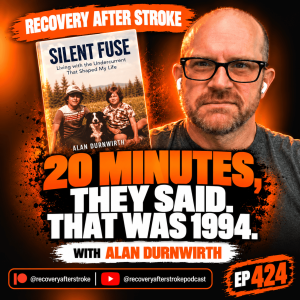
In March 1994, Alan Durnwirth was 24, five months from his wedding, and new to his first management role. After a wisdom tooth extraction he became lethargic and mentally foggy, and his dentist reassured him more than once that recovery can take longer than people expect. Over the following weeks the right side of his face began to droop. Then one morning he woke paralyzed down that side, barely able to say his fiancée’s name.
She drove him to the emergency room, where doctors found an arteriovenous malformation in his left frontal cortex had ruptured. Surgery followed three days later. According to Alan, the surgeon told her afterwards that if she had not acted that morning, he had probably had about twenty minutes.
That was 32 years ago. Alan is 57 now, still married to the woman who got him there, and still recovering — the part of stroke that rarely features in conversations about the first year. Across more than 400 conversations on this show, the survivors furthest from their stroke tend to say a version of the same thing: the effects change, but they do not finish.
What an AVM rupture is, and why it counts as a stroke
An arteriovenous malformation, or AVM, is a tangle of blood vessels in which arteries connect directly to veins, bypassing the capillaries that normally sit between them. Most people who have one are born with it, and many never find out. When an AVM ruptures, blood leaks into surrounding brain tissue, which makes it a hemorrhagic stroke. Alan’s was congenital, and part of it is still there. Two other survivors have described the same event: Juan Gonzales, eleven years on, and Lorenzo Price, a tattoo artist whose AVM upended his working life.
The long-term effects of stroke nobody warns you about
Alan lost the ability to walk, speak, read, and write. He spent one to two weeks in intensive care, about eight weeks in rehab, a long stretch of outpatient care, and roughly eight months before returning to work. Three decades on, what remains is subtler and much harder for other people to see:
- Slower processing and word-finding. His thinking is sometimes slow, and a sentence can stall while he looks for the next word.
- Visual and sensory overload. Screens can bring on nausea and seizure-type sensations if he pushes too far.
- Fatigue. For years he put it down to ordinary eye strain.
- Focal epilepsy and right-sided fine-motor weakness, both of which he still manages.
Fatigue, slowed processing and sensitivity to stimulation are among the most commonly reported long-term effects of stroke, and because none of it shows, it is easy for others to wave away. The deficits no one can see and cognitive fatigue after stroke are the subjects survivors raise with me most often, usually long after everyone else has stopped asking.
Alan’s workarounds are worth borrowing. He stands up and walks every 30 minutes. He asks people to email a recap after phone calls so he has a written record. And when a thought drops out mid-conversation, he asks for a second, which reads as careful thinking.
When the symptoms hide in plain sight
Long before the rupture, Alan was losing small pieces of time. In class he would miss five seconds, thirty seconds, sometimes more. His teachers saw a daydreamer. He decided he was an anxious child. He became skilled at covering the gaps, and his wife of five years saw something she had no name for.
He had no brain scan until just before surgery, at almost 25. Only afterwards did he understand those lost moments were seizures. Not every daydreamer has an AVM, but repeated, unexplained lapses deserve a medical conversation rather than a convenient label.
“I think everybody has an undercurrent of something.” — Alan Durnwirth
What 32 years of recovery looks like
There is no finish line. Alan says some days are harder than others, and that he has learned to recognize them and slow down. Recovery now means maintenance: his medication, good nutrition, and walking about ten miles a day, five in the morning and five in the afternoon. Walking began as a way to get back a sense of control, and became the thing that calms his mind.
His career reshaped itself around his brain. Unable to hold the corporate pace, he started a graphic design business from home, taking fewer clients and more time. He still runs it, and it meant both he and his wife were home while their children were small.
Alan also took anti-seizure medication for 15 years and only recognized, after a change, that a persistent low mood had quietly become his normal. A later switch was made without a gradual taper, and the months that followed were frightening enough that his wife connected the timing and his neurologist intervened. That is his personal experience, not advice: never start, stop or change a medication without consulting your doctor.
Turning a lifelong undercurrent into a book

On those long walks, memories he had lost after surgery started coming back. Alan journaled them, several hundred entries, then expanded them into longer pieces, and they became Silent Fuse: Living with the Undercurrent That Shaped My Life. Writing it helped him stop blaming people and circumstances, and let go of old hurt and anger. He now says plainly that he loves himself, and describes the book as almost a love story about his wife.
Psychologists Richard Tedeschi and Lawrence Calhoun call this post-traumatic growth: not the absence of struggle, but the meaning and strength found through it. I have written about the growth you did not know you were having, and my book, The Unexpected Way That A Stroke Became The Best Thing That Happened, offers a path to post-traumatic growth after stroke.
Frequently asked questions
What are the long-term effects of stroke after an AVM rupture?
They vary with where the bleed happened and what treatment was needed. Alan’s include slowed processing, word-finding pauses, sensory overload, fatigue and focal epilepsy. Ask your care team what to expect.
Can you keep recovering decades after a stroke?
Alan says yes. Thirty-two years on, he still notices change. Gains usually slow with time, but many survivors keep adapting and improving for years.
What is an AVM rupture?
It is when an AVM, a tangle of abnormal blood vessels, bursts and bleeds into the brain, causing a hemorrhagic stroke. It is a medical emergency, so seek emergency care immediately.
If a stroke has made your world feel smaller, my new book, Your World Doesn’t Have to Stay This Small, is a practical guide to rebuilding your life after trauma, even when you are not ready. Remember to subscribe so you never miss a survivor story, and if this show has helped you, you can support it at patreon.com/recoveryafterstroke. Alan’s book, Silent Fuse, is on Amazon and at Barnes & Noble.
This blog is for informational purposes only and does not constitute medical advice. Please consult your doctor before making any changes to your health or recovery plan.
Alan Durnwirth: 32 Years After an AVM Rupture and the Undercurrent That Shaped His Life (Interview)
Alan Durnwirth had about 20 minutes when his AVM ruptured at 24. Now 57, he’s still recovering, still walking, and still growing. Hear how.
Highlights:
00:00 They said it was just the tooth
10:59 Why he had to work for himself
15:20 How he hid the missing time
19:00 When the word just goes
27:43 The medication change nobody tapered
42:00 Everybody has an undercurrent
50:55 Twenty minutes to live