What to Do After a Stroke: Your Stroke Recovery Map
By Bill Gasiamis, three-time stroke survivor and host of the Recovery After Stroke podcast
Most of us leave hospital believing the same thing: someone has a plan, and they will tell us what happens next.
Sometimes that is true. Often it is not. You get a discharge summary, a few leaflets and, if you are lucky, a follow-up date. Then you are home, and the questions start. Who do I call about my balance? Is this tiredness normal? Can I drive? Why did this happen to me in the first place?
That gap is what the belief cannot explain. If someone were holding the whole plan, survivors and families would not be searching “what to do after a stroke” at midnight. The truth is that a lot of recovery depends on knowing which questions to ask, and when to ask them.
That is why we created the Stroke Recovery Map.
What is the Stroke Recovery Map?
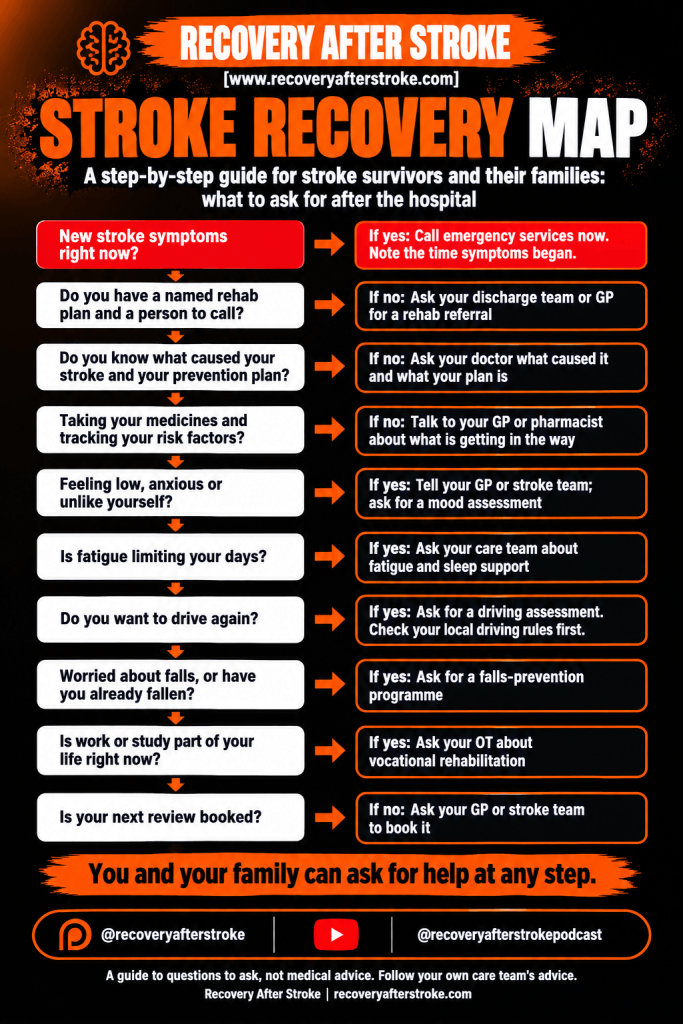
The Stroke Recovery Map is a one-page guide for stroke survivors and their families. It turns the period after hospital discharge into nine check-in questions. Each one points to something you can ask your care team for if the answer is “no” or “not sure”. It does not tell you what treatment to have. It helps you walk into an appointment knowing what to ask for.
It is not specific to one country, so you can use it wherever you live. Where local rules matter, such as driving, the map says so.
What should you do after a stroke?
First, the emergency check. If you or someone near you has new stroke symptoms right now, call your local emergency number and note the time the symptoms began. Nothing else on the map matters until that is handled.
If you are past the emergency, the Stroke Recovery Map asks you nine things:
- Do you have a named rehab plan and a person to call? Rehabilitation goes better when someone owns the plan. If not, ask your discharge team or GP for a rehab referral.
- Do you know what caused your stroke and what your prevention plan is? The cause shapes how you reduce the chance of another one. If not, ask your doctor to explain both.
- Are you taking your medicines and tracking your risk factors? Things like blood pressure matter long after discharge. If something is getting in the way, talk to your GP or pharmacist.
- Are you feeling low, anxious or unlike yourself? Mood changes are common after stroke and they are treatable. Ask for a mood assessment.
- Is fatigue limiting your days? Post-stroke fatigue is real and it is not laziness. Ask about fatigue and sleep support.
- Do you want to drive again? Ask for a driving assessment, and check your local driving rules first, because they differ between countries.
- Are you worried about falls, or have you already fallen? Ask for a falls-prevention programme.
- Is work or study part of your life right now? Ask your occupational therapist about vocational rehabilitation.
- Is your next review booked? Stroke care does not end at discharge. Ask your GP or stroke team to book it.
The last box on the map is the one I care about most: you and your family can ask for help at any step.
Why a map of questions, not answers?
Because the right answer depends on you: your stroke, your health, your country, your care team. A page that pretended otherwise would be unsafe.
What does not change is the shape of good post-stroke care. Stroke guidelines from bodies such as the American Heart Association and American Stroke Association, and the UK’s NICE, consistently describe coordinated rehabilitation, secondary prevention, attention to mood and fatigue, and planned follow-up reviews. The Stroke Recovery Map turns those themes into questions an ordinary person can ask. It is a guide to questions, not medical advice.
Who is the Stroke Recovery Map for?
- Stroke survivors who have just come home and feel they have been handed a pile of paper and no plan.
- Family members and carers who are trying to help and do not know what to ask for.
- People months or years out who suspect something was missed. Question nine, the review, is often the one that was never booked.
I have had three strokes. I know what it is like to be told you are “lucky” and then left to work out the rest yourself. Looking back, the biggest gains came when I started asking better questions.
How do you use it?
- Right-click the Stroke Recovery Map image on this page, save it, and print it on A4.
- Read down the nine questions and mark each yes, no or not sure.
- Take it to your next GP, stroke clinic or therapy appointment.
- Ask about every “no” and “not sure”. Write the answers on the page.
- Share it with a family member so you are not carrying it alone.
What recovery actually runs on
Recovery after stroke does not run on a plan that someone hands you. It runs on questions you are allowed to ask.
The Stroke Recovery Map is one page of those questions. If you want the full story of how I rebuilt my life after three strokes, it is in my book, The Unexpected Way That A Stroke Became The Best Thing That Happened. If you want to support the podcast financially, you can do that through Patreon.
Remember to save your Stroke Recovery Map and take it with you to your next appointment.
This blog is for informational purposes only and does not constitute medical advice. Please consult your doctor before making any changes to your health or recovery plan.